Fabric & Upholstery
Houndstooth in Interior Design: Carpet, Fabric & Walls
Houndstooth is one of the most recognisable patterns in design history, a broken-check motif of pointed, four-pointed shapes that reads as both classic and quietly modern. Originally woven into Scottish wool cloth, it has travelled from tailoring into interiors, where it now appears on upholstery, rugs, cushions and accent walls. For Singapore designers and specifiers, it offers a way to add structure and personality without resorting to busy florals or loud geometrics.
What Houndstooth Is and Where It Comes From
Houndstooth, sometimes called dogtooth, is a two-colour textile pattern made from a specific twill weave. The interlocking shapes are not printed but formed by the way warp and weft threads cross, which is why a true houndstooth has a subtle three-dimensional quality up close.
The pattern traces back to the woven woollen cloth of the Scottish Lowlands, where shepherds and landowners wore it for its durability and camouflage in the field. By the twentieth century it had become a fixture of high tailoring and fashion houses, and from there it crossed into furnishing fabrics and floor coverings.
That heritage is part of the appeal. A houndstooth surface carries a sense of craft and continuity that printed geometrics rarely match, which is why designers reach for it when a scheme needs gravitas. Whether woven in wool, blended with synthetics for performance, or tufted into a carpet, the motif keeps its tailored, considered character.
Dogtooth, Puppytooth and Other Variants
The houndstooth family spans several scales, and choosing the right one is the single biggest decision for an interior scheme. The names are sometimes used loosely, but the distinctions are useful when you are specifying.
- Dogtooth is the standard medium-scale version with bold, clearly pointed shapes, the most familiar form in upholstery and rugs.
- Puppytooth is a smaller, finer version that reads almost as a texture from a distance, ideal for chairs and cushions in compact rooms.
- Large-scale houndstooth blows the motif up into a graphic statement, suited to feature walls, oversized rugs and hospitality settings.
- Tonal and overdyed houndstooth swaps the classic black-and-white for soft two-tone palettes that sit more gently in a residential space.
Where Houndstooth Works in Interiors
Houndstooth is most at home on upholstery, where the weave’s durability and visual structure both come into play. An accent chair, an ottoman or a bench upholstered in a tight houndstooth becomes a focal point without dominating.
It also performs beautifully underfoot. A houndstooth carpet or area rug grounds a room and adds rhythm to an otherwise plain floor, and our carpet collection shows how the motif scales from subtle to bold. Beyond seating and floors, the pattern lifts cushions, throws, drapery and even a single accent wall in wallcovering form. The key is to pick one or two surfaces and let them lead.
Drapery deserves a special mention. A houndstooth curtain, especially in a tonal palette, frames a window without the heaviness of a large floral, and it filters Singapore’s bright daylight in an attractive, graphic way. On walls, the pattern is best confined to a single feature surface, such as the wall behind a bed or a banquette, where it acts as a built-in headboard of pattern rather than wrapping the whole room.
Choosing Scale and Colour
Scale governs how loud the pattern feels. A fine puppytooth recedes and behaves almost like a solid, while a large-scale motif demands attention and needs breathing room around it. In smaller Singapore apartments, smaller scales usually sit more comfortably.
Colour does similar work. Classic black-and-white houndstooth is crisp and high-contrast, perfect for a confident, graphic statement. Tonal combinations such as taupe and cream, navy and slate, or charcoal and grey soften the effect and make the pattern far easier to live with over time.
Using Houndstooth as an Accent Without Overwhelming a Room
Houndstooth is a strong pattern, so restraint is what makes it look considered rather than chaotic. Treat it as a seasoning, not the main dish. One upholstered piece, a pair of cushions, or a rug is usually enough to carry a whole scheme.
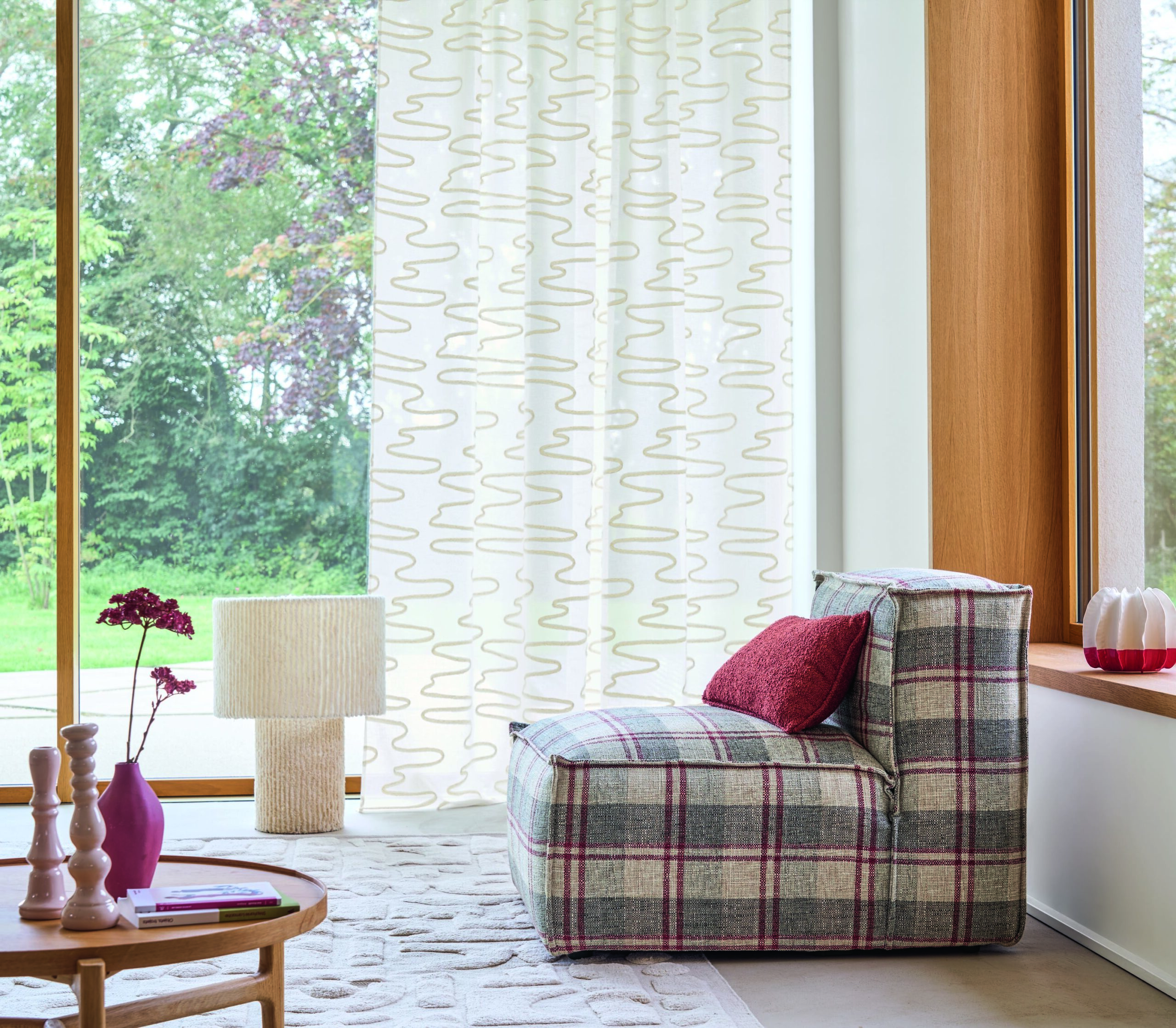
Balance the pattern with generous areas of plain colour and tactile, unpatterned textures. A houndstooth chair reads as deliberate when it sits beside a smooth linen sofa and a plain wool rug; surround it with three other patterns and it disappears into noise. Velvet and boucle make especially good companions because their texture contrasts with the flat graphic weave, as our guide to velvet upholstery explores in more detail.
Pairing Houndstooth With Plains and Textures
The reliable formula is one statement pattern, supported by solids and quiet textures. Pull a single colour from the houndstooth and repeat it in plain cushions, drapery or a painted wall to tie the room together.
When you do want to layer pattern on pattern, vary the scale so the eye can separate them. A large houndstooth rug can sit happily under a small woven check or a tonal stripe. For richer combinations, a houndstooth piece works well alongside woven jacquard fabrics that share the same heritage, structured sensibility. Explore our full upholstery fabric collection to find complementary plains and textures.
Residential Versus Commercial and Hospitality Use
In homes, houndstooth tends to be used sparingly and in softer, tonal palettes that age gracefully. A reading chair, a window seat or a hallway runner are typical residential applications where the pattern adds character to a single moment in the room.
In commercial and hospitality interiors, houndstooth can be braver. Hotels, restaurants and members’ clubs use large-scale or high-contrast houndstooth carpet and upholstery to signal a tailored, heritage-luxe identity. These settings also demand harder-wearing constructions, since the pattern must survive far heavier traffic than a domestic equivalent.
There is also a practical advantage to houndstooth in busy spaces. The broken, two-tone pattern disguises minor marks and uneven soiling far better than a flat solid, which is why it has long been favoured for carpet in lobbies and corridors. For contract projects, always confirm fire-retardancy ratings and abrasion performance against the relevant Singapore standards before specifying.
Fabric Performance and Care
Because houndstooth is so often a woven wool or wool-blend cloth, performance matters as much as looks. For upholstery, check the abrasion rating, usually expressed as a Martindale rub count, and match it to the use. Light residential use needs around 15,000 to 25,000 rubs, general domestic use 25,000 to 40,000, and commercial or hospitality seating 40,000 and above.
Wool houndstooth is naturally resilient and resists soiling well, which is one reason it has stayed popular for centuries; our wool upholstery guide covers this in depth. Care is straightforward: vacuum regularly, blot spills promptly rather than rubbing, and rotate cushions to even out wear. In Singapore’s humidity, keep upholstered and carpeted houndstooth out of prolonged direct sun and ensure good airflow to protect the fibres.
Houndstooth Compared to Other Classic Patterns
It helps to see where houndstooth sits among the other heritage weaves a specifier reaches for. Each has a different scale, formality and natural home.
| Pattern | Typical Scale | Formality | Best Use |
|---|---|---|---|
| Houndstooth | Small to large | Smart, tailored | Accent chairs, rugs, cushions, feature walls |
| Herringbone | Fine to medium | Subtle, versatile | Sofas, carpet, drapery as a near-solid |
| Jacquard | Medium to large | Formal, luxurious | Statement upholstery, drapery, headboards |
| Tartan / Check | Medium to large | Traditional, cosy | Throws, cushions, country-style seating |
Herringbone is the quietest of the group and reads almost as texture, jacquard the most decorative, and tartan the most overtly traditional. Houndstooth lands in the sweet spot: graphic enough to be noticed, disciplined enough to stay tasteful.
Final Thoughts
Houndstooth rewards a confident but light touch. Choose a scale and palette that suit the room, anchor it with plains and texture, and it brings instant heritage and structure to a Singapore interior. Used well, one houndstooth piece can define an entire scheme.
Request samples of our houndstooth and patterned upholstery fabrics from our Singapore showroom.