Wallpaper & Wallcovering
Soundproof Wall Solutions for Singapore Homes and Offices
Soundproof wall solutions are increasingly sought after in Singapore, where high-density living and open-plan office environments make unwanted noise a persistent challenge. Whether you are dealing with traffic noise in an HDB flat, neighbour disturbances in a condo, or excessive reverberation in a commercial office, the right wall treatment can make a measurable difference to acoustic comfort.
This guide examines practical wall-based approaches to sound management, from acoustic wallcoverings to specialist panel systems, with a focus on solutions that work within Singapore’s building context.
Understanding Noise Problems in Singapore
Singapore’s built environment creates specific noise challenges that shape the demand for soundproofing solutions.
In residential settings, the primary concerns are airborne noise from neighbours (conversations, television, music), impact noise transmitted through shared walls and floors, and external noise from traffic and construction. HDB flats, with their reinforced concrete party walls, generally perform better than lightweight drywall partitions found in some newer condominiums, but even concrete walls transmit sound at certain frequencies.
In offices, the challenge is different. Open-plan layouts — dominant in Singapore’s CBD and business parks — create environments where conversations, phone calls, and meeting discussions blend into a constant background hum that reduces concentration and productivity. Meeting rooms with insufficient acoustic treatment allow confidential discussions to be heard outside.
Understanding the type of noise you need to address is the first step toward selecting an effective solution. Airborne sound, impact sound, and reverberation each require different treatment approaches.
Types of Soundproof Wall Solutions
Wall-based acoustic solutions fall into several categories, each addressing different aspects of sound management.
Acoustic Wallcoverings
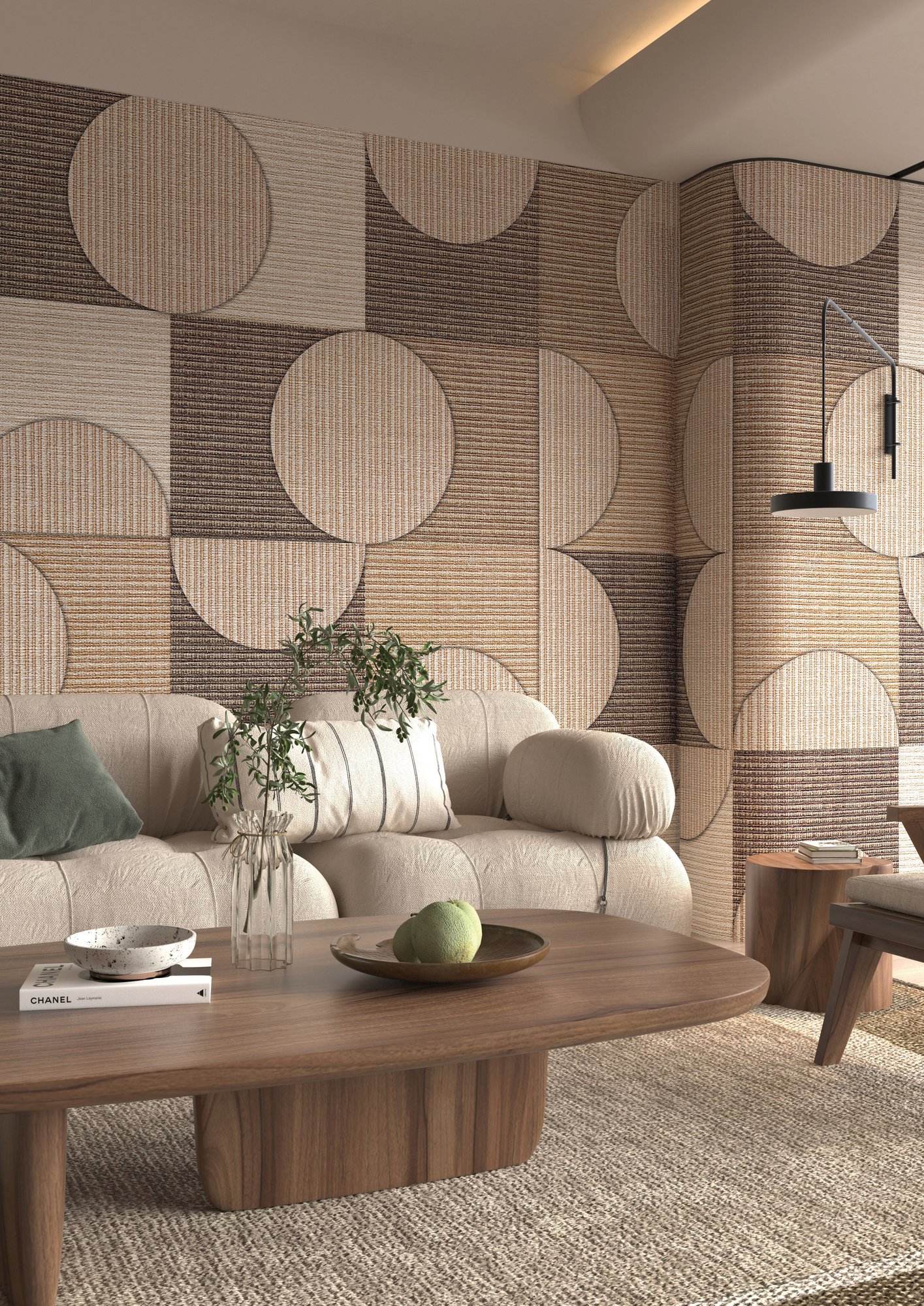
Acoustic wallcoverings are specialist wall finishes that combine decorative appearance with sound-absorbing properties. Unlike standard wallpaper, these products incorporate layers of acoustic foam, felt, or fibrous material behind a decorative face. They reduce reverberation and echo within a room — particularly effective in offices, meeting rooms, and home theatres.
Acoustic wallcoverings are thicker than standard wallpaper, typically ranging from 2mm to 6mm, and carry a Noise Reduction Coefficient (NRC) rating that indicates their sound absorption capability. An NRC of 0.30 to 0.50 is typical for acoustic wallcoverings, meaning they absorb 30 to 50 percent of the sound energy that strikes them.
Fabric-Wrapped Acoustic Panels
These panels consist of a rigid or semi-rigid acoustic core — usually fibreglass or mineral wool — wrapped in decorative fabric. They can be mounted directly onto walls in custom sizes and arrangements, offering both high acoustic performance and design flexibility.
Fabric-wrapped panels are particularly popular in meeting rooms, boardrooms, and home cinemas where both sound quality and aesthetic appeal are priorities. NRC ratings of 0.70 to 0.95 make them significantly more effective than acoustic wallcoverings for sound absorption.
Mass-Loaded Vinyl (MLV)
For blocking sound transmission through walls — rather than absorbing sound within a room — mass-loaded vinyl is a proven solution. This dense, flexible material is installed behind plasterboard or within wall cavities to add mass and reduce the passage of airborne sound.
MLV is particularly useful in condo bedrooms sharing a party wall with a neighbour, or in office meeting rooms where speech privacy is essential. It adds as little as 6mm of wall thickness, making it practical for renovations where space is at a premium.
Please note: Goodrich Global does not supply mass-loaded vinyl — it is a construction material that your renovation contractor would source and install. We include it here for completeness: MLV blocks sound behind the wall, while our acoustic wallcoverings and fabric-wrapped panels manage sound within the room, and the two approaches work best together.
Resilient Channel and Decoupled Wall Systems
For the highest levels of sound isolation, walls can be constructed or retrofitted with resilient channels — metal strips that mechanically decouple the plasterboard from the wall studs. This decoupling breaks the path of sound vibration, significantly reducing transmission.
This approach is most practical during renovation or new construction, as it involves modifying the wall structure. In Singapore HDB flats undergoing major renovation, adding a decoupled wall layer on a shared party wall can noticeably reduce neighbour noise.
Comparing Wall Soundproofing Options
| Solution | Primary Function | NRC Rating | Best Application |
|---|---|---|---|
| Acoustic wallcovering | Sound absorption | 0.30 – 0.50 | Offices, meeting rooms, restaurants |
| Fabric-wrapped panels | Sound absorption | 0.70 – 0.95 | Boardrooms, home cinemas, studios |
| Mass-loaded vinyl (contractor-supplied; not a Goodrich product) | Sound blocking | N/A (STC rated) | Party walls, meeting room partitions |
| Resilient channel | Sound blocking | N/A (STC rated) | New build, major renovation |
| Acoustic plasterboard | Sound blocking | N/A (STC rated) | Office partitions, home walls |
Soundproofing Solutions for Singapore Homes
Residential soundproofing in Singapore typically focuses on bedrooms, home offices, and living areas. The approach depends on whether you are dealing with internal noise (within your own home) or external noise (from neighbours or the street).
HDB Flats
HDB party walls are typically 150mm to 200mm reinforced concrete, which provides reasonable sound isolation. However, noise still transmits through these walls, especially low-frequency bass sounds. Adding a new plasterboard lining with acoustic insulation in the cavity can improve the wall’s sound transmission class (STC) — a perceptible reduction.
For rooms where echo and reverberation are the issue — common in sparsely furnished BTO units — acoustic wallcoverings or strategically placed fabric panels provide effective treatment without taking up floor space.
Condominiums
Many newer condos use lightweight drywall partitions between rooms, which transmit sound more readily than concrete. Upgrading these partitions with acoustic insulation or acoustic plasterboard during renovation is the most effective approach. For party walls between units, the options are more limited, but surface-mounted solutions can still help.
Landed Properties
Semi-detached and terrace houses share party walls with neighbours. These walls vary significantly in construction — from solid brick to cavity walls — and the soundproofing approach must be tailored to the existing structure. A professional acoustic assessment is recommended before specifying solutions.
Soundproofing Solutions for Offices
Office acoustic treatment in Singapore has become a priority as companies recognise the link between noise levels and employee productivity.
Meeting rooms require a combination of sound absorption (to improve speech clarity within the room) and sound blocking (to prevent conversations from being overheard outside). Acoustic wallcoverings on two or three walls, combined with an acoustic ceiling, typically deliver adequate performance for standard meeting rooms. For executive boardrooms and legal offices where confidentiality is paramount, full acoustic wall construction with decoupled systems may be necessary.
Open-plan work areas benefit from acoustic wallcoverings on adjacent walls and columns, which reduce the reflection of speech sounds and lower the overall ambient noise level. Combined with acoustic ceiling tiles and carpet flooring, these treatments create a noticeably quieter work environment.
Goodrich Global offers a range of wallcoverings with acoustic properties suitable for both office and residential applications, combining sound management with sophisticated design.
Final Thoughts
Effective soundproofing starts with understanding the specific noise problem you face and selecting the solution that addresses it. Wall treatments — from acoustic wallcoverings that tame reverberation to decoupled wall systems that block transmission — offer practical options for both residential and commercial environments in Singapore.
The best results come from combining multiple approaches: absorptive surfaces, mass barriers, and structural decoupling work together to create genuinely quiet spaces.
Request free samples from our Singapore showroom to explore acoustic wallcovering options for your project.