Industry Insights
Airport Lounge and Corridor Material Specification
Airport interiors are among the most demanding commercial specification briefs in existence. The traffic load is continuous, twenty-four hours of the day, every day of the year. The visual language carries the airport operator’s brand — and increasingly, the destination’s national brand — to every passenger, business traveller, and crew member who passes through. The maintenance window for any flooring or wallcovering is operational rather than overnight; the asset cannot pause. And the material specifications must deliver fire compliance, slip resistance, acoustic performance, and indoor-air-quality outcomes appropriate to confined-volume spaces with high passenger throughput.
At Goodrich, airport-interior specifications are part of our long-form commercial portfolio in Singapore and across our regional markets. References include Changi Airport Terminal 1 VIP Corridor, Changi Airport Terminal 2 Bus Gate, Crowne Plaza Changi Airport, F1 Pit Building, the Marina Cruise Centre, and across regional aviation work in Indonesia, India, China, Hong Kong, and Dubai. This article sets out the framework we apply to aviation interior briefs.
The Aviation Specification Brief: Continuous Operation
The defining constraint of aviation interiors is operational continuity. Terminal floors operate 24/7. Lounge interiors operate on the airline’s flight schedule. Gate areas turn over every 30 to 90 minutes during operating hours. Corridor and circulation traffic is continuous. There is no overnight closure for refurbishment work — installations and replacements must happen in operational windows that may be measured in hours rather than days.
This shapes the specification calculus in concrete ways:
- Service life expectations are longer than most commercial work. The capital cost of an airport flooring replacement is high, and the operational cost of refurbishment work is substantial; specifications target 12 to 20 years of service life rather than the 7 to 10 typical of hospitality.
- Replaceability without full closure is essential. Specifications that allow zone-by-zone replacement, individual carpet tile replacement, or panel replacement under operational conditions are structurally preferred over those that require full-area shutdown.
- Cleaning chemistry compatibility is critical. Airport cleaning regimes use commercial-grade chemistry at high frequency. Materials must tolerate the cleaning protocol across the full service life.
- Fire compliance is regulated at higher specification levels than typical commercial. Public assembly, transportation hub, and passenger-circulation requirements all apply.
- Acoustic specification matters at aviation scale. Terminal volumes amplify acoustic problems; gate area conversation, public address announcements, and ambient airport noise compete unless absorption is engineered in.
Specification by Aviation Space Type
Premium lounges
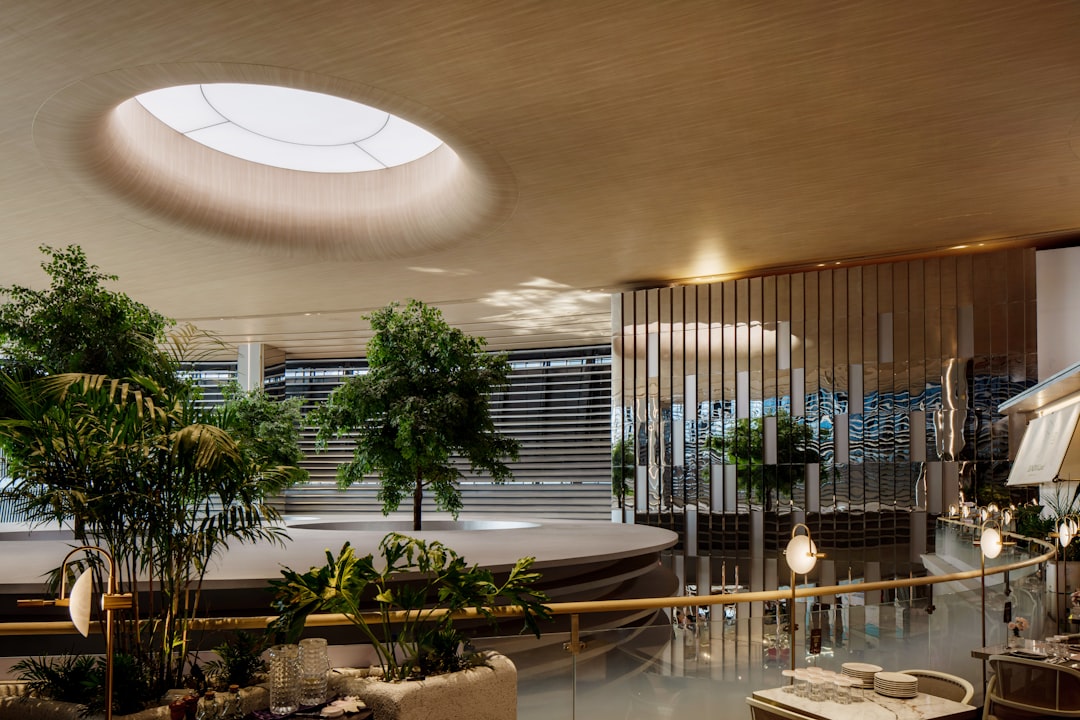
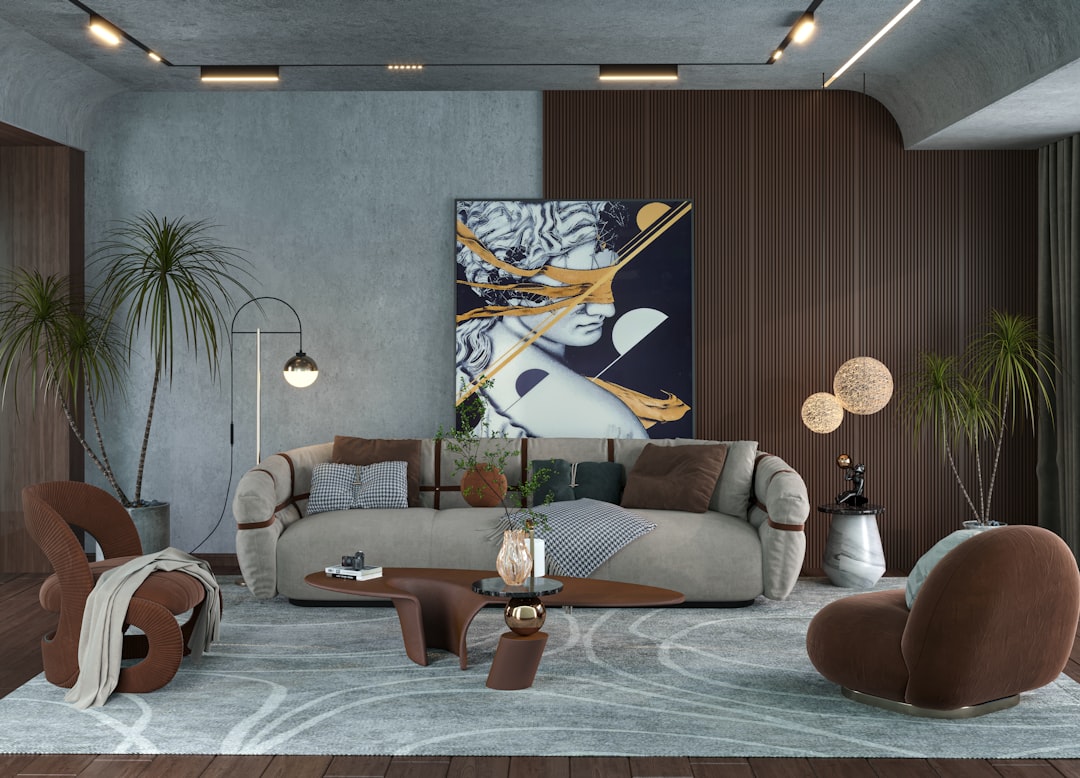
Airline premium lounges, banking and credit-card-issuer lounges, and independent operator lounges (Plaza Premium, No1, etc.) operate at hospitality-grade specification levels. The brief is hotel-lobby-equivalent finish quality, airport-grade durability, and continuous-operation reliability.
Specification answers: woven axminster broadloom or hand-tufted broadloom carpet at hospitality grade for signature lounge spaces (Goodrich’s Axminster and hand-tufted ranges, both SGBC-certified, customisation available), durable vinyl wallcoverings at premium finish (Premierwall Azurite, Sangetsu XSELECT, handpainted Goodrich Exclusive Artistic for hero walls), contract-grade fabric (Aldeco, Camengo, Sanderson, Sangetsu, Concertex) and silicone faux leather (Shield Leathers — anti-mildew, hydrolysis-resistant, suitable for the cleaning regime) on seating, and decorative glass film (Sangetsu CLEAS — UV cut 99%, scatter prevention, energy savings) on glazed elevations to protect interior finishes from UV exposure.
The acoustic specification is hospitality-equivalent: acoustic wallcoverings on continuous wall surfaces, acoustic ceiling treatment, fabric wall panels at feature positions. Lounge guests expect a quiet atmospheric experience that contrasts with the gate-area hubbub.
VIP corridors and arrival/departure routes
VIP corridor specifications — Changi T1 VIP Corridor is the canonical Goodrich reference — combine extended service life with hospitality-grade finish quality. The specification typically uses custom carpet (axminster or hand-tufted depending on the design language) at premium grade, durable wallcoverings, and integrated lighting and signage.
Gate areas and boarding lounges
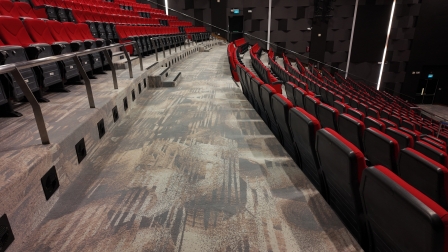
Gate area flooring is among the highest-load specifications in any commercial interior. Continuous passenger traffic, rolling luggage, mobile equipment, occasional spillage, and frequent cleaning combine to a load profile that consumer or hospitality specifications would not survive. Custom axminster broadloom and modular carpet tile (Tuntex, Goodrich carpet tile range) are the typical answers depending on the operator’s preference for continuous broadloom or modular replaceability.
Specification considerations: extended service life targeting 15 years plus, high pile density and tuft anchorage for the traffic profile, fire compliance for public-assembly use, design language coordinated with the operator’s brand programme.
Terminal corridors and airside circulation
Terminal corridor specifications work at the largest scale of any commercial flooring brief. Continuous broadloom across hundreds of metres of corridor run with custom-design integration, fire compliance, anti-slip rating where required, and replaceability planning over the asset’s life. The specification typically combines custom axminster broadloom for primary visual zones with carpet tile for back-of-house and operational zones, plus vinyl plank in transition and equipment-staging areas.
Retail and F&B within the terminal
Airport retail and F&B operate at hospitality-grade specification with continuous-operation requirements. Specification answers parallel the chain-rollout F&B framework: anti-slip vinyl flooring for kitchens (Sangetsu NONSKID, S Floor at R11 minimum), antimicrobial flooring for food-prep zones (Orchid 3000, Armstrong Medintech Plus), durable upholstery (Shield Leathers, contract-grade fabrics), and architectural film (REATEC) for fast-cycle refresh of joinery and feature surfaces.
Wet zones and washrooms
Airport washroom flooring carries continuous use, frequent cleaning, slip-and-fall liability, and antimicrobial expectation. Anti-slip vinyl at appropriate slip class (Sangetsu NONSKID, S Floor with anti-slip rating), antimicrobial-grade flooring (Orchid 3000), wall protection (P3TEC, Korogard) in cleaning-machine impact zones, and decorative glass film for partition privacy and UV cut where exterior glazing is part of the bathroom design.
The Replaceability Imperative
Aviation interior specifications must plan for replacement under operational conditions. Carpet tile is structurally preferred where the design language allows because individual tiles can be replaced overnight without full-zone closure. Where broadloom is specified, the installation should use jointing details that allow zone-by-zone replacement rather than continuous-length monolithic installation that cannot be replaced piecemeal.
Wallcovering specifications similarly favour replaceability: fixing detailing that allows single-panel replacement, joint placement at corners or transitions where partial replacement reads as deliberate, and supplier relationships with stock-holding commitments that allow quick replacement when damage events occur.
Acoustic Specification at Aviation Scale
Airport terminals are large-volume spaces with high acoustic loading from public address, conversation, equipment movement, and ambient mechanical noise. The acoustic budget is spread across multiple surfaces: ceiling treatment is usually engineered at terminal scale by the architectural team; floor absorption from carpet contributes meaningfully; wall absorption from acoustic wallcoverings or panels addresses speech and conversation; and seating and lounge upholstery contributes additional absorption in lounge and gate areas.
The integration of these contributions requires acoustic-engineering consultation at design stage. Material specification supports the engineered acoustic budget; it does not deliver acoustic outcomes alone.
Sustainability and Certification
Aviation operators increasingly pursue sustainability commitments at the asset and at the operational level. Material specifications support these in several ways:
- SGBC-certified flooring across vinyl, carpet, and decking specifications support BCA Green Mark and equivalent certifications.
- Recycled-content materials (carpet with recycled-content yarns, recycled-fibre wallcoverings, composite decking with recycled polymer) support Scope 3 emissions and circular-procurement reporting.
- Low-VOC and IAQ-certified materials support WELL and IAQ-focused certifications.
- Long-service-life specifications reduce lifecycle replacement frequency and the embodied carbon associated with replacement cycles.
For Singapore aviation projects pursuing Green Mark certification, the Goodrich specification range across carpet, flooring, wallcovering, fabric, and outdoor decking carries the relevant certifications.
The Multi-Project Reality
Aviation operators rolling out across multiple terminals, multiple airports, or multiple commercial concessions within a single airport benefit from specification consistency at the operator level. Same product specifications mean same maintenance and replacement protocols across sites; consistent visual brand across terminals supports the operator’s brand programme; framework supplier agreements scale across the rollout.
The Specification Process
The shortest path to confident aviation specification is a structured brief covering: site footprint and zoning, traffic profile and 24/7 operational requirements, brand and design language, certification commitments, refurbishment cycle and replaceability requirements, supplier framework requirements, and budget envelope. The master specification follows.
Speak to our team to scope an aviation interior material specification. Browse references in the Goodrich e-catalogue, see project case studies, or explore the full carpet and flooring collections that cover aviation specification needs.