Carpet & Flooring
Resilient Flooring Types Explained: A Complete Guide
Resilient flooring types encompass a broad family of flexible, durable materials that have become the fastest-growing segment in the Singapore flooring market. Unlike rigid materials such as ceramic tile or natural stone, resilient floors bend and recover under pressure, offering comfort, sound absorption, and design versatility that hard surfaces cannot match.
Understanding the differences between the various resilient flooring types will help you select the right product for your residential or commercial project.
What Makes Flooring “Resilient”?
The term “resilient” refers to a floor’s ability to recover its shape after compression. When you step on a resilient floor, it yields slightly under your weight, absorbing impact energy, and then springs back to its original form once the pressure is released.
This characteristic delivers several practical benefits. Resilient floors are more comfortable to stand on for extended periods, reduce noise transmission between floors, and are gentler on dropped items compared to hard surfaces. They also tend to be warmer underfoot than ceramic or stone.
The main categories of resilient flooring include luxury vinyl tiles (LVT), stone polymer composite (SPC), vinyl composition tiles (VCT), vinyl sheet, rubber, cork, and linoleum. Each has distinct properties suited to different applications.
Luxury Vinyl Tiles (LVT)
LVT is the most popular resilient flooring type in Singapore’s residential and commercial markets. It consists of multiple layers: a backing layer for stability, a core layer (typically PVC), a photographic design layer, and a transparent wear layer on top.
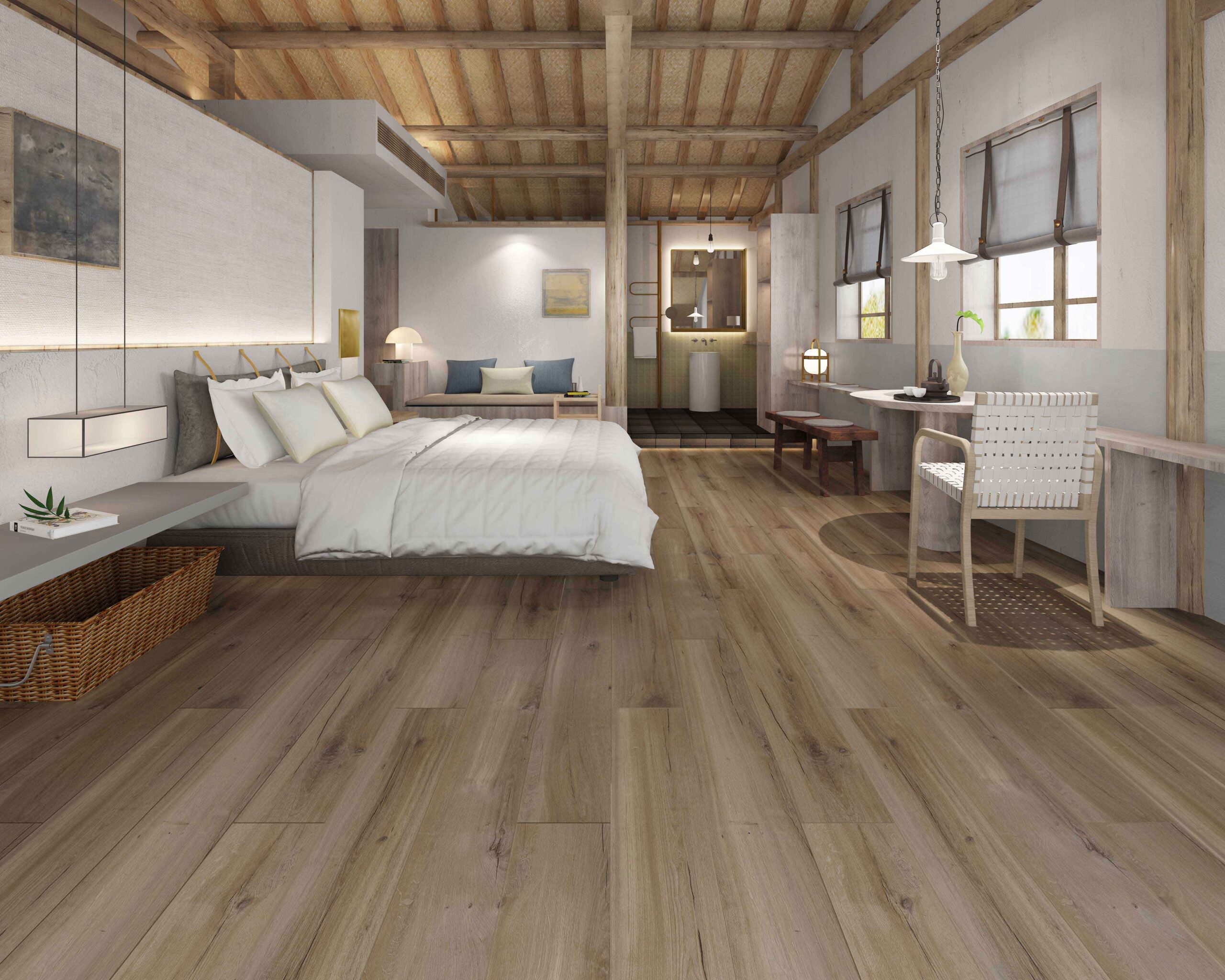
The photographic layer can reproduce virtually any material, from oak planks and marble slabs to concrete and terrazzo. Print technology has advanced to the point where LVT is often indistinguishable from natural materials at a glance.
LVT is flexible, relatively thin (typically 2 mm to 5 mm), and available in glue-down, click-lock, and loose-lay installation formats. It performs well in both residential and commercial settings, with commercial-grade products offering wear layers of 0.5 mm or more for high-traffic durability.
Key advantages include waterproof performance, ease of maintenance, wide design choice, and competitive pricing. Explore luxury vinyl flooring options to see the range available for Singapore projects.
Stone Polymer Composite (SPC)
SPC flooring is a rigid-core variant within the vinyl flooring family. Its core is made from a blend of limestone powder (calcium carbonate) and PVC, creating a dense, dimensionally stable plank that resists expansion and contraction far better than standard LVT.
The rigid core makes SPC feel more like a hard surface underfoot compared to flexible LVT, though it is still more comfortable than ceramic tile. SPC is typically installed as a floating floor with a click-lock mechanism, making it one of the easier flooring types for renovation projects.
SPC excels in environments with variable conditions. It handles temperature fluctuations, humidity changes, and direct sunlight without warping or buckling. For Singapore homes with large windows and variable air-conditioning use, this dimensional stability is a significant advantage.
Vinyl Sheet Flooring
Vinyl sheet comes in large rolls, typically 1.5 m to 4 m wide, and is cut to fit the room in a single piece or with minimal seams. This makes it an excellent choice for spaces where hygiene is a priority, such as healthcare facilities, commercial kitchens, and laboratories.
The near-seamless installation minimises places where moisture, bacteria, or dirt can accumulate. Heat-welded seams create a completely watertight surface that can be coved up walls for full containment.
In residential settings, vinyl sheet is commonly used in kitchens, laundry areas, and bathrooms. It is affordable, easy to clean, and available in a wide range of patterns and colours.
Other Resilient Flooring Types
Rubber Flooring
Rubber flooring is prized for its exceptional shock absorption, slip resistance, and acoustic performance. It is widely used in gyms, hospitals, schools, and transit facilities. Rubber floors are extremely durable and can withstand heavy rolling loads from trolleys and equipment.
In Singapore, rubber flooring is commonly specified for MRT station platforms, hospital corridors, and commercial gym facilities.
Linoleum
Linoleum is made from natural materials including linseed oil, cork dust, wood flour, and jute backing. It is one of the oldest resilient flooring types, predating vinyl by nearly a century. Modern linoleum offers excellent durability, natural antimicrobial properties, and strong sustainability credentials.
Linoleum is popular in healthcare and educational settings across Europe and is gaining traction in Singapore projects where environmental certifications are required.
Cork Flooring
Cork is harvested from the bark of cork oak trees without harming the tree, making it a renewable material. It offers natural thermal and acoustic insulation, a comfortable walking surface, and antimicrobial properties.
Cork is less common in Singapore due to humidity concerns, but engineered cork products with sealed surfaces are viable for air-conditioned residential spaces.
Comparing Resilient Flooring Types
| Type | Durability | Water Resistance | Comfort | Best For |
|---|---|---|---|---|
| LVT | High | Waterproof | Good | Residential, retail, offices |
| SPC | Very high | Waterproof | Moderate | High-traffic residential, commercial |
| Vinyl sheet | High | Waterproof (seamless) | Good | Healthcare, kitchens, wet areas |
| Rubber | Very high | Water resistant | Excellent | Gyms, hospitals, transit |
| Linoleum | High | Moderate | Good | Healthcare, education |
| Cork | Moderate | Low (unless sealed) | Excellent | Residential (climate-controlled) |
Choosing the Right Resilient Floor for Your Project
The best resilient flooring type depends on your specific application, traffic levels, moisture exposure, and design requirements.
- For HDB and condo renovations: LVT or SPC offers the best balance of aesthetics, durability, and moisture resistance.
- For commercial offices: LVT with a 0.5 mm wear layer provides long-term performance and easy maintenance.
- For healthcare facilities: Vinyl sheet with heat-welded seams delivers the hygiene performance required.
- For fitness centres: Rubber flooring provides the shock absorption and durability that heavy equipment demands.
- For sustainability-focused projects: Linoleum or cork aligns with green building requirements.
Whichever type you select, ensure the product meets relevant performance standards for wear resistance, slip rating, and fire safety. Consult the full flooring range to compare products suited to your project.
Final Thoughts
Resilient flooring types offer solutions for virtually every interior application, from family homes to hospital wards. Their combination of durability, comfort, and design flexibility makes them an increasingly popular choice across Singapore’s residential and commercial sectors.
Request free samples from our Singapore showroom to experience the differences between resilient flooring types firsthand.