Carpet & Flooring
Types of Vinyl Flooring: LVT, SPC, Sheet Compared
Understanding the Main Types of Vinyl Flooring
Vinyl flooring has evolved from a single product category into a diverse family of formats, each engineered for specific applications. For Singapore homeowners and designers navigating the options, understanding these distinctions is essential to choosing a floor that performs well in your specific environment.
The primary types of vinyl flooring differ in their core construction, installation method, thickness, and performance characteristics. While they all share vinyl’s fundamental benefits — water resistance, durability, and design versatility — they diverge significantly in how they handle foot traffic, subfloor imperfections, and temperature fluctuations.
Luxury Vinyl Tile and Plank (LVT/LVP)
Luxury vinyl flooring represents the premium end of the vinyl spectrum. Available in both tile and plank formats, LVT (Luxury Vinyl Tile) and LVP (Luxury Vinyl Plank) feature multi-layer construction with high-definition printed designs and robust wear layers.
The typical construction of LVT/LVP includes:
- Backing layer: Provides dimensional stability and sound absorption
- Core layer: A flexible PVC core that gives the product its resilience
- Design layer: High-resolution printed film replicating wood, stone, or abstract patterns
- Wear layer: Clear PVC coating (0.3 mm to 0.7 mm) that resists scratches and staining
- Surface treatment: UV-cured polyurethane for enhanced stain resistance and easier cleaning
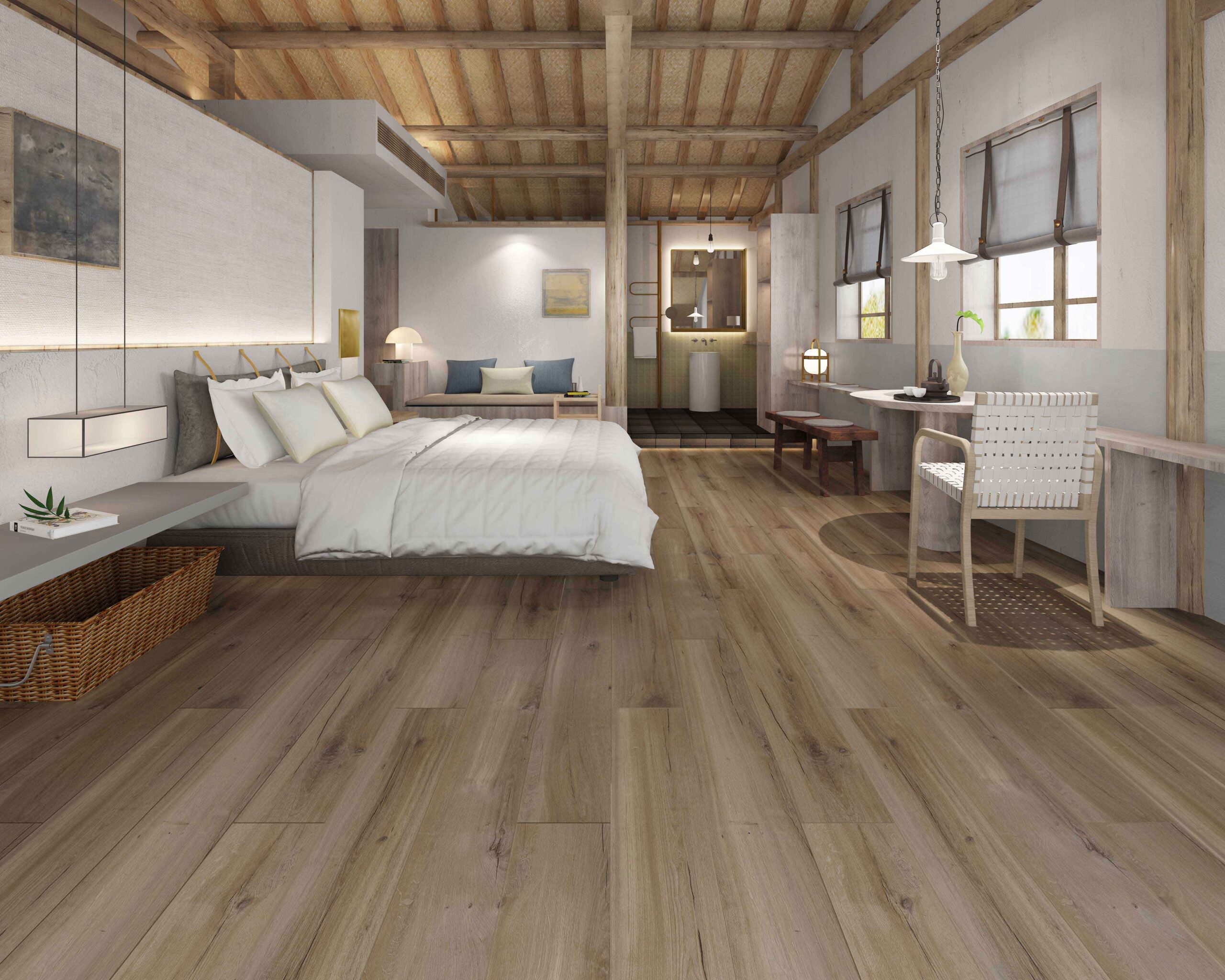
LVT is particularly popular for its ability to replicate natural materials with exceptional realism. Registered embossing — where the surface texture aligns precisely with the printed pattern — creates both visual and tactile authenticity. Planks typically measure 150 mm to 230 mm wide and 900 mm to 1,500 mm long, mimicking the proportions of real timber boards.
Stone Polymer Composite (SPC) Flooring
SPC flooring has rapidly gained market share in Singapore due to its rigid core construction. The core is composed of limestone powder, polyvinyl chloride, and stabilisers, creating a dense, dimensionally stable plank that resists expansion and contraction caused by temperature changes.
| Property | SPC | Standard LVT |
|---|---|---|
| Core material | Stone polymer composite (rigid) | Flexible PVC |
| Dimensional stability | Excellent | Good |
| Subfloor tolerance | Handles minor imperfections | Requires smooth subfloor |
| Underfoot comfort | Firmer feel | Softer, more cushioned |
| Installation | Click-lock (floating) | Glue-down or click-lock |
| Typical thickness | 3.5 mm to 6 mm | 2 mm to 5 mm |
| Indent resistance | Superior | Moderate |
SPC’s rigid core makes it particularly suitable for installation over existing tile floors — a common scenario in Singapore where homeowners want to avoid the cost and disruption of hacking. The click-lock mechanism allows floating installation without adhesive, further simplifying the process.
The trade-off is underfoot comfort. SPC feels harder than flexible LVT, though this can be mitigated with an attached or separate cork or IXPE underlayment.
Wood Polymer Composite (WPC) Flooring
WPC flooring sits between SPC and traditional LVT in terms of construction. Its core blends wood flour or bamboo powder with PVC and foaming agents, creating a semi-rigid plank that offers better underfoot comfort than SPC while maintaining good dimensional stability.
WPC planks are typically thicker than SPC (5 mm to 8 mm), which contributes to superior sound insulation and a warmer feel underfoot. The foamed core also provides inherent thermal insulation, making the floor comfortable in air-conditioned Singapore homes without the cold feel of tiles.
However, WPC is generally less dense than SPC, making it slightly more susceptible to heavy point loads from furniture legs. It is also marginally less water-resistant than SPC, though still fully suitable for residential wet areas when properly installed.
Vinyl Sheet Flooring
Vinyl sheet flooring comes in continuous rolls, typically 2 to 4 metres wide, and is installed as a single piece across the room. This format predates LVT and SPC but remains relevant for specific applications where its seamless surface is advantageous.
The primary benefit of sheet vinyl is its virtually seam-free installation, making it a reliable choice among the broader flooring category. In bathrooms, kitchens, and laundry areas, this eliminates the risk of moisture penetrating through joints — a genuine advantage over plank and tile formats in Singapore’s humid climate.
Sheet vinyl is thinner than LVT or SPC, typically ranging from 1.5 mm to 3.5 mm, and requires full adhesive installation on a smooth subfloor. While it offers fewer design options than plank formats, modern sheet vinyl features high-quality printing that convincingly replicates wood, stone, and geometric patterns.
Hybrid and Loose-Lay Vinyl
Beyond the main categories, two additional formats are worth noting. Hybrid vinyl flooring combines elements of SPC and WPC construction, using a rigid mineral core with enhanced acoustic properties. Some hybrid products include an integrated cork or rubber underlayment that simplifies installation while delivering excellent sound performance — a compelling option for condo residents who need to meet strict acoustic standards.
Loose-lay vinyl is a thick, heavy plank format designed to stay in place under its own weight without click-locks or adhesive. The planks feature a friction-grip backing that holds them to smooth subfloors. This format allows rapid installation and easy removal, making it ideal for commercial tenancies and rental properties where flooring may need to change with each occupant.
Loose-lay vinyl requires an exceptionally smooth, clean subfloor to work properly. Any debris or texture beneath the planks can prevent the friction backing from gripping effectively, leading to movement over time. For this reason, it is less commonly used in residential renovations where subfloor preparation may be limited.
Choosing the Right Type for Your Space
The best type of vinyl flooring depends on your specific circumstances. Consider these factors when making your decision.
Existing subfloor condition: If you are laying over existing tiles without hacking, SPC’s rigid core handles lippage (height differences between tiles) better than flexible LVT or sheet vinyl. For smooth, well-prepared subfloors, any format works well.
Room function: Wet areas such as bathrooms and kitchens benefit from sheet vinyl’s seamless surface or SPC’s superior water resistance. Living rooms and bedrooms may prioritise the underfoot comfort of WPC or flexible LVT.
Noise considerations: Condo residents subject to inter-floor noise regulations should consider WPC for its superior acoustic properties, or SPC/LVT with attached acoustic underlayment. Sheet vinyl also provides reasonable sound dampening.
Installation preferences: If you prefer a floating installation that can be removed and reinstalled (useful for tenants), SPC with click-lock is the clear choice. Permanent installations in owned properties can use any format.
Budget and longevity: Consider the total cost of ownership, not just the upfront price per square foot. A thicker wear layer (0.5 mm versus 0.3 mm) costs more initially but may add several years of lifespan — making the cost per year of use lower. Similarly, products with pre-attached acoustic underlayment eliminate the separate underlayment purchase, potentially offering better overall value despite a higher unit price.
Design priorities: If visual realism is paramount, premium LVT with registered embossing and wide-plank formats delivers the most authentic timber or stone appearance. SPC and WPC products are rapidly closing this gap, but the finest LVT collections still lead in design sophistication. For commercial applications where durability outweighs aesthetic concerns, SPC’s practical advantages often take precedence.
Explore the full range of vinyl flooring options available in Singapore. Browse our e-catalogue for the latest designs and find the vinyl type that matches your project requirements.