Healthcare Interiors
Hospital Flooring Requirements and Best Options – Goodrich
Hospital flooring requirements are among the most stringent in the built environment. Every surface in a healthcare facility must support infection control, patient safety, staff comfort, and operational durability — all while meeting Singapore’s regulatory standards.
This guide examines the key requirements for hospital flooring and evaluates the most suitable materials for different healthcare zones.
Core Requirements for Hospital Flooring
Hospital flooring must satisfy a demanding set of performance criteria that go far beyond the requirements of commercial or residential applications.
Hygiene and Infection Control
Infection control is the primary concern in healthcare flooring. The surface must be non-porous, resistant to chemical disinfectants, and free of joints or seams where bacteria can harbour. Homogeneous vinyl sheet flooring with heat-welded seams is the gold standard because it creates a continuous, impervious surface that can be cleaned and disinfected repeatedly without degradation.
In Singapore, healthcare facilities must comply with the Ministry of Health’s infection control guidelines, which specify standards for surface cleanability and maintenance protocols. Flooring that cannot withstand frequent cleaning with hospital-grade disinfectants is unsuitable for clinical areas.
Slip Resistance
Falls are a major safety concern in hospitals, affecting both patients and staff. Flooring must provide adequate slip resistance, even when wet — a frequent condition in hospitals due to cleaning protocols, spills, and procedures.
The recommended coefficient of friction for hospital flooring is 0.5 or higher in dry conditions and 0.4 or higher in wet conditions. Materials should be tested to international standards such as ASTM D2047 or BS 7976 (pendulum test) to verify performance.
Durability and Maintenance
Hospital flooring endures 24-hour use, heavy equipment loads, wheeled traffic from beds and trolleys, and aggressive cleaning regimes. Materials must resist indentation, scratching, and chemical damage over a lifespan of 15 to 20 years or more.
Low-maintenance flooring reduces operational costs — an important consideration for Singapore’s healthcare operators. Materials that require minimal waxing, polishing, or recoating are preferred.
Acoustic Performance
Noise levels in hospitals directly affect patient recovery and staff performance. Flooring that absorbs impact sound — footsteps, trolley wheels, dropped equipment — contributes to a quieter environment. Resilient flooring options such as vinyl sheet and LVT with acoustic backing outperform hard surfaces like terrazzo and ceramic tile in this regard.
Flooring Options for Healthcare Facilities
| Material | Best For | Key Properties |
|---|---|---|
| Homogeneous vinyl sheet | Operating theatres, ICU, sterile zones | Seamless, non-porous, chemical resistant |
| Heterogeneous vinyl sheet | Corridors, wards, outpatient areas | Durable wear layer, design options, easy maintenance |
| Luxury vinyl tile (LVT) | Waiting areas, admin offices, lobbies | Design versatility, comfort, moderate durability |
| Rubber flooring | Rehabilitation rooms, gyms | Impact absorption, slip resistance, durability |
| Vinyl safety flooring | Wet areas, bathrooms, kitchens | Enhanced slip resistance, waterproof |
Homogeneous Vinyl Sheet
This is the preferred choice for high-hygiene clinical areas. The material is consistent throughout its thickness, meaning the surface can be maintained and restored over its lifetime. Heat-welded seams create a monolithic surface with no gaps for bacteria to colonise. It is available in a wide range of colours for wayfinding and zone identification.
Heterogeneous Vinyl Sheet
Multi-layered vinyl sheet flooring offers a broader range of designs and textures while maintaining the essential properties of hygiene and durability. It is commonly specified for general wards, corridors, and outpatient departments where the extreme hygiene demands of operating theatres do not apply.
Luxury Vinyl Tile
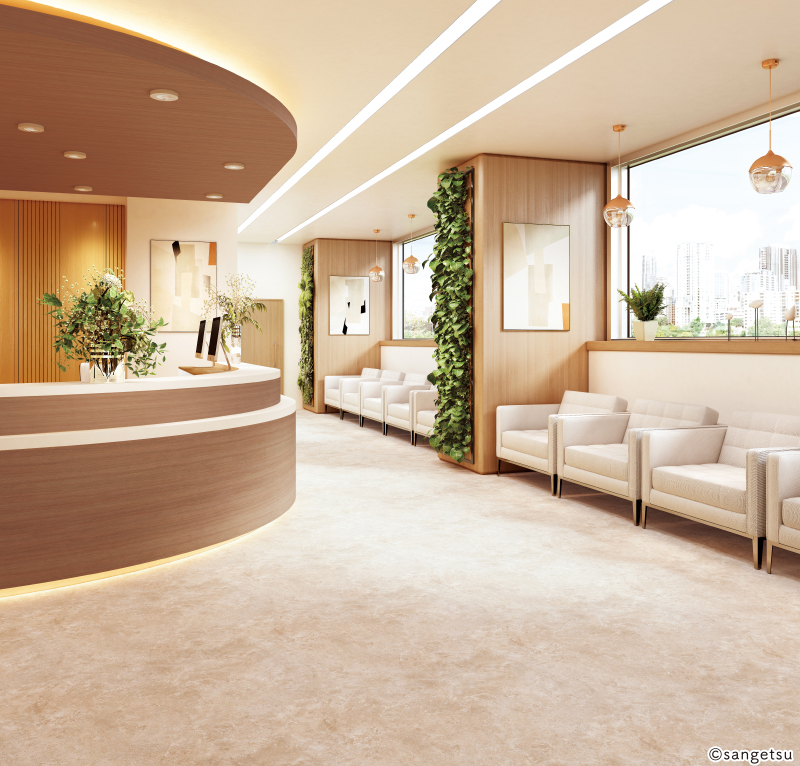
Luxury vinyl tile is well-suited to non-clinical hospital areas — reception lobbies, administrative offices, staff rooms, and waiting areas. It offers superior design options, including realistic wood and stone finishes, that help these areas feel welcoming rather than institutional. LVT with antimicrobial surface treatments adds an extra layer of hygiene protection.
Zoning: Matching Flooring to Function
Hospitals are not monolithic environments — different areas have vastly different requirements, and flooring should be specified zone by zone.
Critical Care and Surgical Areas
Operating theatres, intensive care units, and sterile processing areas demand the highest hygiene standards. Homogeneous vinyl sheet with heat-welded seams and integral cove bases (where the flooring curves up the wall) eliminates dirt traps at wall-floor junctions. Antistatic properties are also essential in areas with sensitive electronic equipment.
General Wards and Corridors
These high-traffic areas require durable, easy-to-clean flooring with good acoustic properties. Heterogeneous vinyl sheet is the typical choice. Colour-coding corridors aids wayfinding for patients, visitors, and staff navigating large hospital complexes.
Patient Rooms
Patient room flooring should balance hygiene with a more homely, comforting atmosphere. Vinyl sheet in warm tones or wood-look finishes can make rooms feel less clinical, which research suggests supports faster recovery and improved patient satisfaction.
Public and Administrative Areas
Lobbies, cafeterias, and offices can use a wider range of materials, including LVT and carpet tiles in low-risk areas. These spaces benefit from design-forward materials that create a welcoming first impression for patients and visitors.
Installation and Lifecycle Considerations
Proper installation is critical for hospital flooring performance. Subfloor preparation, moisture testing, adhesive selection, and seam welding must all be executed to manufacturer specifications. Poor installation compromises hygiene, durability, and safety — and remediation in an operational hospital is extremely disruptive and costly.
Lifecycle cost analysis should factor in not just the initial material and installation cost but ongoing maintenance, cleaning frequency, and expected lifespan. Hospital-grade vinyl flooring typically lasts 15 to 25 years depending on traffic and maintenance, while cheaper alternatives may need replacement in 5 to 10 years — a false economy when the disruption of replacement in a functioning hospital is considered.
Final Thoughts
Hospital flooring requirements demand materials that prioritise hygiene, safety, durability, and acoustic comfort. In Singapore’s healthcare environment, where regulatory compliance and patient outcomes are paramount, flooring specification is a decision that affects clinical performance, operational efficiency, and the healing environment for years to come.
Working with experienced suppliers who understand healthcare standards ensures that the right material is specified for every zone, installed correctly, and maintained for optimum performance.
Get a free quote for healthcare-grade flooring solutions suited to hospitals and clinics in Singapore.