Carpet & Flooring
Teak Looking Vinyl Flooring in Singapore:Easier Alternatives
Teak wood flooring occupies a special place in Southeast Asian building memory. It is the timber of heritage shophouse staircases, colonial-era verandahs and yacht decks — a material whose reputation was earned over centuries in exactly the hot, wet conditions Singapore serves up daily. Few species carry that kind of pedigree.
Yet in 2026, specifying real teak is harder to justify than at any point in its history. Supply ethics, cost and maintenance have all moved against it, while the alternatives have quietly become excellent. This guide gives teak its due, explains honestly why it has become a difficult specification, and maps the easier routes to the same warm, golden-brown result indoors.
Goodrich Global does not supply solid teak flooring. Our range covers teak-tone wood-look vinyl flooring for interiors and composite timber decking for outdoor areas, both delivering the teak aesthetic without the sourcing and maintenance burden.
Indoors: Teak-Tone Vinyl Planks
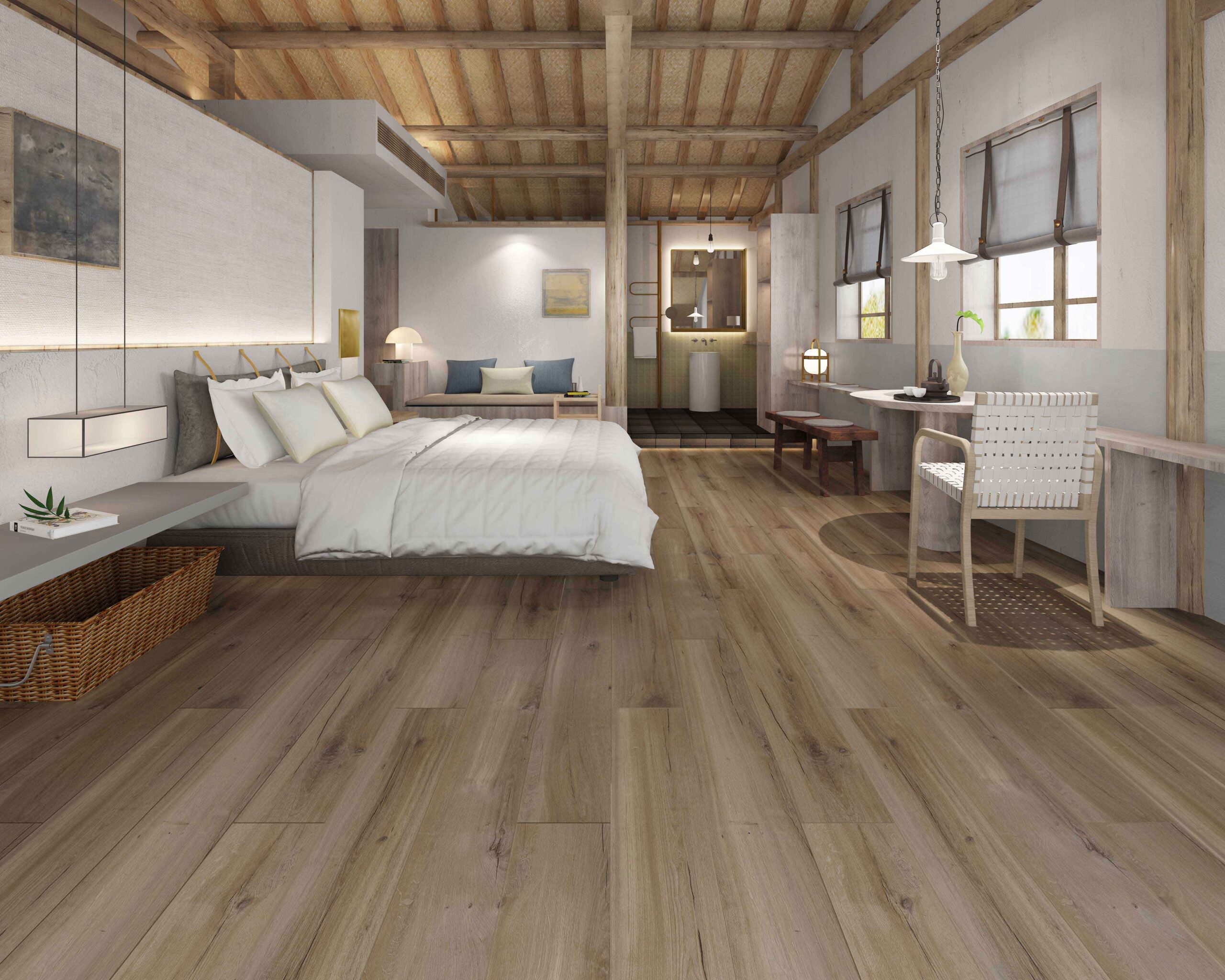
For living rooms, bedrooms and commercial interiors, teak-tone luxury vinyl planks reproduce the golden-brown tone and characteristic striped grain convincingly, with registered embossing giving the surface real texture rather than a flat print. Plank and herringbone formats both carry the tone well, and because the colour is engineered rather than weathered, every board in the room matches — no sorting, no acclimatising, no surprises when the crate opens. The practical advantages compound in this climate: vinyl is fully waterproof, indifferent to humidity and air-conditioning cycles, and needs nothing beyond routine cleaning — no oil, no sanding, no colour management.
It is also dramatically more accessible. A teak-look vinyl floor costs a quarter to a half of the solid article, lays over existing tiles in HDB flats and condos without hacking, and a damaged plank is replaced individually rather than repaired by a specialist. For most interiors, this is the teak look solved.
Outdoors: Composite Timber Decking
Balconies, roof terraces, planter surrounds and pool decks are where teak’s maintenance burden bites hardest — and where composite timber has matured furthest. Composite decking from the Goodrich outdoor decking range delivers warm timber tones and a brushed woodgrain surface that never needs oiling, will not rot, splinter or feed termites, and holds its colour evenly instead of greying patch by patch under uneven sun and rain exposure.
Supply is the quieter advantage. Composite boards are manufactured to consistent dimensions and tone, so a deck extension two years later matches the original — something plantation teak cannot promise. Installation is faster too: boards fix to standard joist or pedestal systems with concealed clips, and condo management committees approve composite far more readily than natural timber precisely because it removes the long-term maintenance question from the building’s books. For how composite decking stacks up against tiles, natural timber and other exterior surfaces, see our outdoor flooring options guide for Singapore.
Final Thoughts
Teak wood flooring earned its legend honestly, and in heritage and marine settings it still has no equal. For everyone else, the calculus has flipped: sourcing genuine quality is ethically and practically fraught, the price is punishing, and the maintenance never ends. Teak-tone vinyl indoors and Goodrich composite decking outdoors deliver what most people actually wanted from teak — the warmth, the toughness, the tropical ease — without inheriting its problems.
Request samples of teak-tone vinyl planks and Goodrich decking boards to see how close the match runs in your own light.