Carpet & Flooring
Wood-Look Vinyl vs Real Wood: Which Flooring Is Better?
The Great Flooring Debate
Few decisions in home renovation spark as much discussion as choosing between wood-look vinyl and real wood flooring. Both deliver the warmth and beauty of timber, but they differ significantly in performance, maintenance and suitability for Singapore’s tropical climate.
This comparison covers the practical factors that matter most for Singapore homeowners — from humidity resistance to long-term maintenance — so you can make the right choice for your home.
Understanding Both Options
Real wood flooring includes solid hardwood planks cut from a single piece of timber and engineered wood flooring, which consists of a real wood veneer bonded to a plywood or HDF core. Engineered wood is the more common choice in Singapore due to its improved dimensional stability.
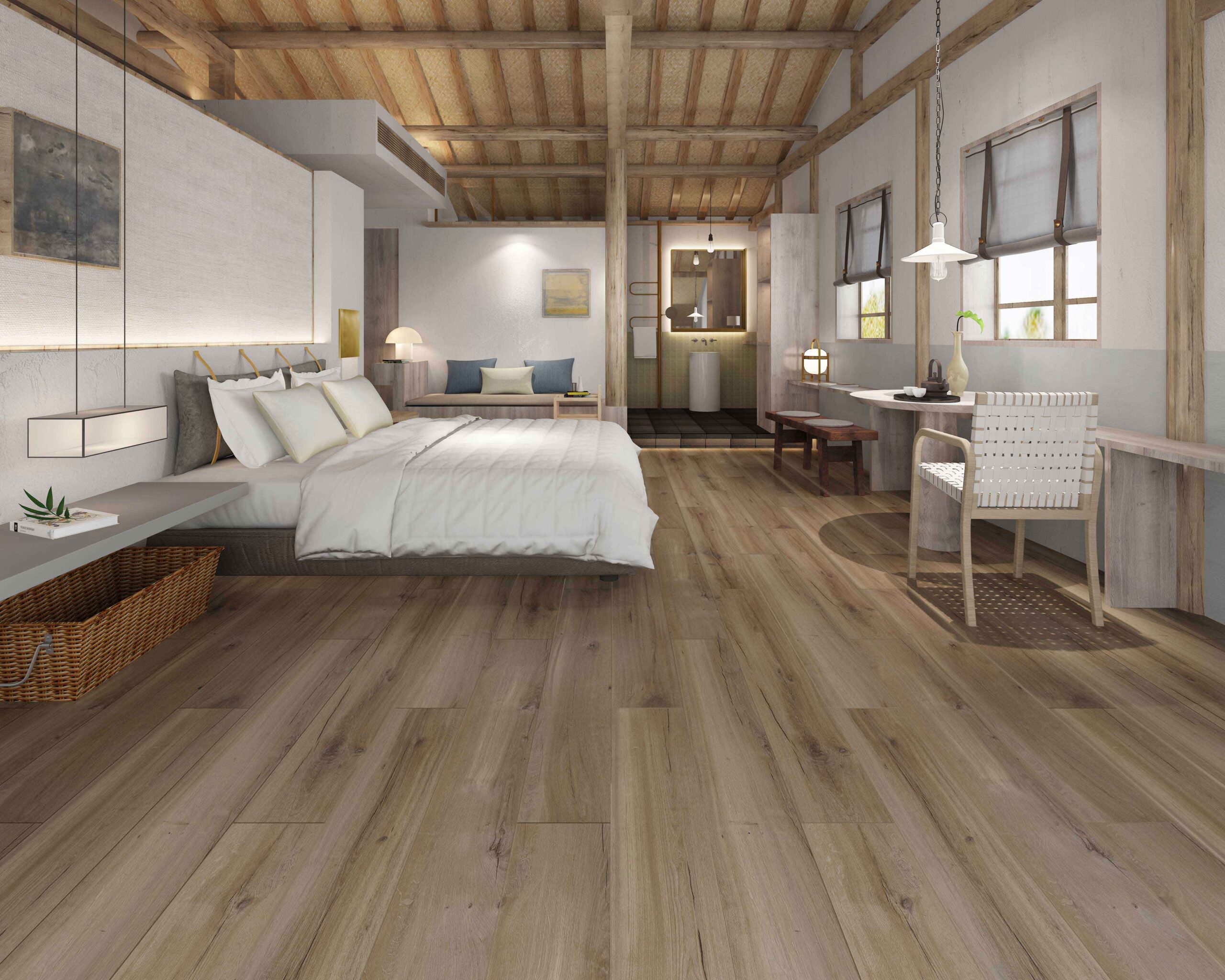
Wood-look vinyl flooring is a luxury vinyl tile (LVT) or luxury vinyl plank (LVP) with a high-definition printed layer that replicates timber grain, knots and colour variations. Premium products use embossed-in-register (EIR) technology, where the texture aligns precisely with the printed grain for a remarkably realistic appearance.
Today’s luxury vinyl planks are so convincing that many people cannot tell the difference without touching the floor. The gap in visual quality between vinyl and real wood has narrowed dramatically.
Head-to-Head Comparison
| Factor | Real Wood (Engineered) | Wood-Look Vinyl (LVT/LVP) |
|---|---|---|
| Water resistance | Low — swells and warps when wet | Fully waterproof |
| Humidity tolerance | Moderate — may gap or cup | Excellent — stable in all conditions |
| Scratch resistance | Low to moderate | High (depending on wear layer) |
| Comfort underfoot | Warm and natural | Slightly warmer with cushioned backing |
| Sound | Hollow sound possible | Quieter with built-in underlay |
| Installation time | 3 to 5 days | 1 to 2 days |
| Lifespan | 20 to 30 years (refinishable) | 15 to 20 years |
| Environmental impact | Natural material, but harvesting concerns | Recyclable options available |
| Refinishing | Can be sanded and refinished | Cannot be refinished |
Why Singapore’s Climate Matters
Singapore’s year-round humidity, which typically ranges from 70 to 90 per cent, is the single most important factor in this decision. Real wood is a hygroscopic material — it absorbs and releases moisture as conditions change. Even with air-conditioning, the daily fluctuation between cooled indoor air and natural humidity can cause solid and engineered wood to expand, contract, gap or cup over time.
Homeowners with real wood floors often discover that gaps appear between planks in air-conditioned rooms, while planks may cup or buckle near windows and in rooms without consistent climate control. The open-plan layouts common in modern HDB flats and condominiums exacerbate this issue, as different zones of the home experience varying temperature and humidity levels throughout the day.
Wood-look vinyl is entirely unaffected by humidity changes. It will not gap, swell or warp regardless of conditions, making it inherently better suited to Singapore’s tropical environment. This dimensional stability is arguably the strongest argument in vinyl’s favour for local homeowners.
Practical Performance in Daily Life
Beyond climate resilience, the day-to-day performance of your floor matters enormously. Here is how the two options compare in typical Singapore household scenarios.
Kitchens and dining areas: Spills are inevitable. With real wood, even a small water spill left unattended can cause permanent staining or localised swelling. Wood-look vinyl handles spills without any consequence, making it the practical choice for areas near sinks and dining tables.
Homes with children: Toys dropped on real wood leave dents that cannot be easily repaired. Vinyl’s resilient surface absorbs impact better and resists scratching, keeping the floor looking newer for longer in high-activity households.
Pet owners: Claws and accidents make real wood a risky choice. Vinyl flooring resists scratching from pet claws and is impervious to pet-related moisture, making it the favoured option for households with dogs or cats.
Helper’s quarters and utility areas: These hardworking spaces benefit from vinyl’s durability and easy maintenance. Real wood in high-traffic, moisture-prone areas is generally not recommended.
Cleaning routines: Vinyl can be damp-mopped liberally without concern. Real wood must be cleaned with a well-wrung mop using wood-specific cleaning products — excess moisture is its enemy. For households with a helper managing daily cleaning, vinyl is simpler to maintain correctly and leaves less room for accidental damage from overly wet mopping.
Installation and Renovation Considerations
The installation process differs meaningfully between wood-look vinyl and real wood, and this has implications for your renovation timeline and overall project costs.
Wood-look vinyl can be installed using click-lock or glue-down methods. Click-lock planks interlock without adhesive, creating a floating floor that can be installed over existing tiles — eliminating the need for hacking. This overlay capability saves days of demolition work, reduces renovation noise and lowers disposal costs. A typical four-room HDB flat can be completed in one to two days.
Real wood installation is more involved. The subfloor must be carefully prepared, moisture barriers laid, and the planks either glued or nailed down. Engineered wood requires acclimatisation in the room for several days before installation to adjust to the ambient humidity. The entire process typically takes three to five days for the same sized flat, not including subfloor preparation time.
For homeowners living in the property during renovation, vinyl’s faster installation means less disruption to daily life. This is a particularly important consideration for families with young children or elderly members who are sensitive to prolonged construction activity.
When Real Wood Makes Sense
Despite vinyl’s practical advantages, there are situations where real wood remains the preferred choice. Landed homes with proper climate control throughout, premium condominium units where the floor’s tactile quality is paramount and homeowners who value the ability to refinish their floors after 10 to 15 years may still favour real wood.
Engineered wood flooring — with its cross-layered construction — performs significantly better than solid hardwood in Singapore conditions. If you do choose real wood, engineered options with a thick wear layer of at least 3 mm offer the best balance of beauty, stability and longevity.
However, even engineered wood requires more care than vinyl. You will need to maintain consistent indoor humidity levels, wipe up spills immediately and avoid wet-mopping. Regular polishing and occasional professional maintenance are also part of the commitment.
Making Your Decision
For most Singapore homeowners, wood-look vinyl flooring offers the best combination of aesthetics, durability and practicality. It delivers the warmth and beauty of timber without the ongoing maintenance concerns that come with real wood in a tropical climate.
Consider your specific circumstances when deciding:
- If you prioritise low maintenance and water resistance, choose vinyl
- If you have young children or pets, vinyl’s resilience is a significant advantage
- If you want flooring for wet or semi-wet areas, vinyl is the only viable choice
- If you value the ability to refinish your floor decades later, consider engineered wood
- If you want the most authentic tactile experience, real wood still has an edge
Many homeowners take a hybrid approach — using wood-look vinyl in living areas, kitchens and children’s rooms where practicality matters most, and reserving real wood for the master bedroom where the tactile experience can be fully appreciated.
To compare wood-look vinyl options side by side, browse the full flooring range or get a free quote for your project today. Our consultants can help you find the perfect wood-look vinyl that matches your desired timber species and finish.