Industry Insights
Hand-Tufted vs Axminster Carpet for Hospitality Projects
The decision between hand-tufted and axminster carpet is one of the most consequential a hospitality designer or procurement lead will make on a project. Both can produce a custom-designed broadloom carpet that fits a single ballroom or threads continuously through a corridor. Both are specified in five-star Singapore hotels every week. But the construction, the cost basis, the lead times, and the on-site behaviour over a ten-year service life are materially different — and choosing badly is the kind of mistake that turns up only when it is too late to change.
At Goodrich, hand-tufted and axminster broadloom carpets sit on parallel tracks in our hospitality range, and we spend a lot of project briefing time helping specifiers decide between them. The decision is rarely “which is better” — it is “which is better for this room, this brief, this budget, and this rate of refurbishment.” This article sets out the framework we use, grounded in the construction techniques, certifications, and live project work that shape the choice.
What Hand-Tufted Carpet Is — and Is Not
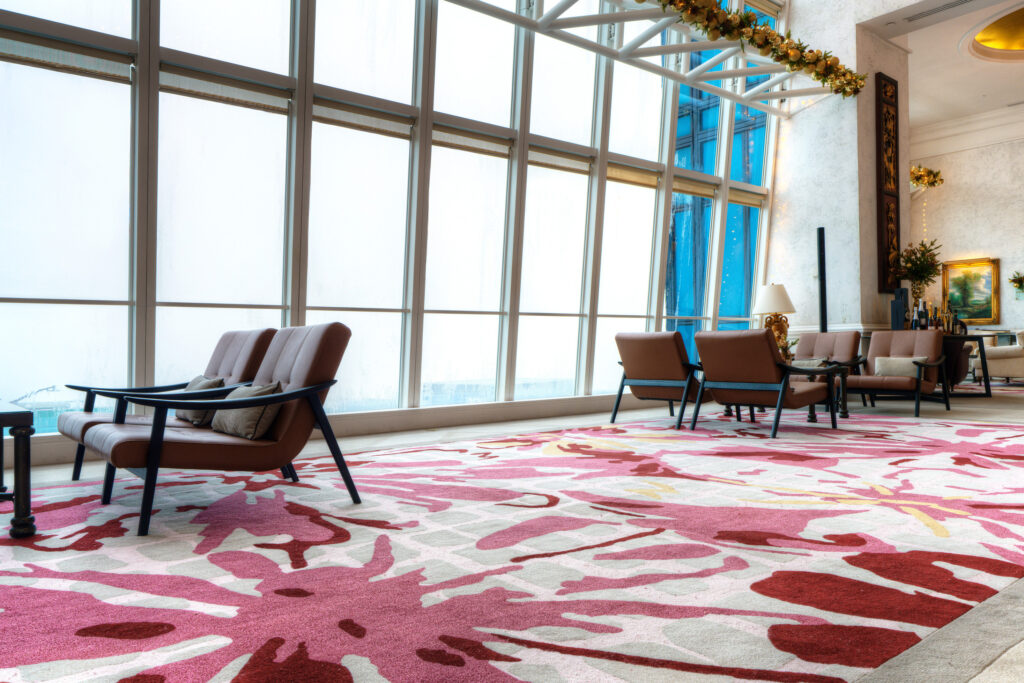
Hand-tufted broadloom carpet is built one tuft at a time, by hand, using a tufting gun on a stretched primary backing. The carpet maker works from a paper pattern at full scale, punching wool, nylon, silk, or bamboo yarn into the backing in the required colours, then trimming the pile to the specified height. After tufting, a secondary backing is bonded on with latex, the carpet is washed, sheared, and finished.
The defining feature is design freedom. Because each tuft is placed by hand, hand-tufted carpet can render any pattern at any scale in any combination of colours and pile heights. Multi-level pile, carved details, irregular curves, photorealistic motifs, brand marks, gradients across hundreds of colours — these are all routine for a hand-tufted maker. The constraint is not the loom, it is the design.
The trade-offs are equally specific. Pile density is typically lower than woven axminster — most hand-tufted product lands between 4mm and 14mm pile height with densities of 1,800 to 2,500 grams per square metre. Wear performance is determined largely by the latex bond between the primary and secondary backing; on the best products this is excellent for a 7- to 10-year service life in five-star front-of-house, but it is not equivalent to woven construction in true very-high-traffic areas like a casino floor or an airport corridor. Hand-tufted is for rooms where design impact justifies the spec — ballrooms, presidential suites, branded restaurant interiors, signature lobby zones.
What Axminster Carpet Is — and Why It Is Different
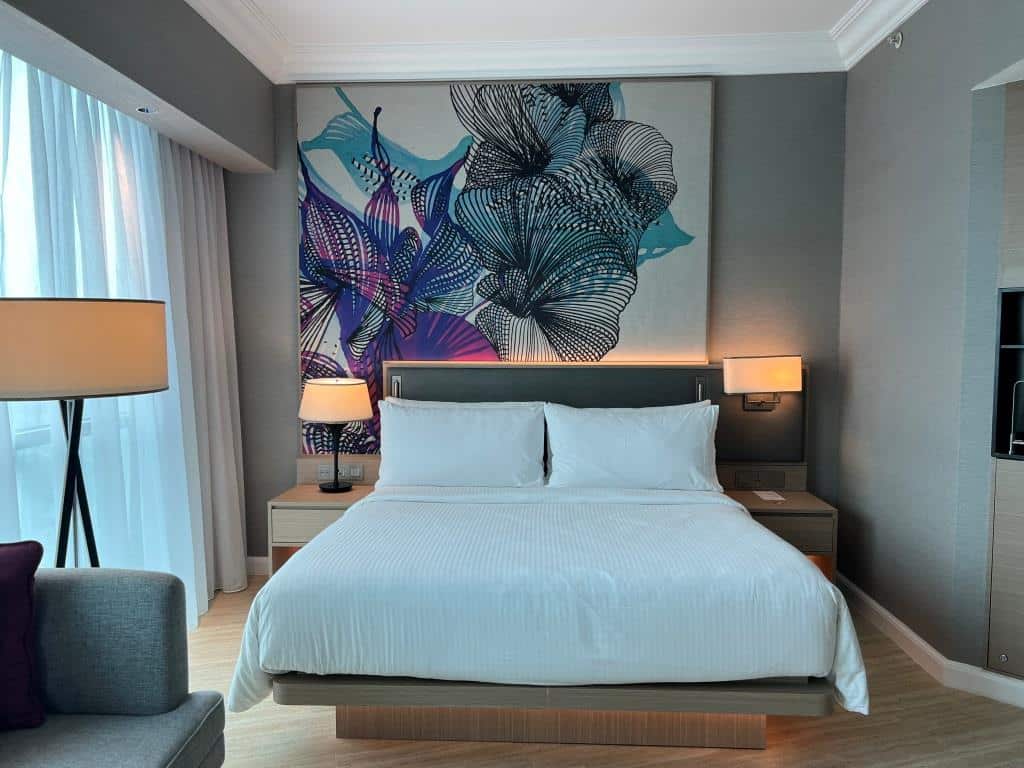
Axminster is a woven construction. The pattern is woven into the carpet on a loom — typically a gripper, gripper-jacquard, or spool axminster — at the same time as the backing. Each tuft is anchored mechanically into the weave structure, not bonded chemically. The carpet that comes off the loom is structurally complete; it does not need a secondary backing for tuft retention.
This construction has direct implications for performance. Tuft anchorage in a woven axminster does not depend on latex; the wool tufts cannot be pulled out individually under abrasive load. Pile density at the working face is typically higher (2,500 to 4,000 g/m²) and densities in the high 80% pile-recovery range allow the carpet to take very-high-traffic without crushing. Service lives of 12 to 15 years in main hospitality public areas are routine, with proper underlay and maintenance.
The trade-off is design. Axminster pattern design is constrained by the loom — typically eight to twelve colours in standard production, woven in a fixed pattern repeat. The repeat length and weft width are loom-dependent. Bespoke designs are entirely possible — and at Goodrich we run customised axminster regularly — but the design must be developed within the technical constraints of the loom on which it will be woven. Multi-pile-height effects, photographic realism, or hundreds of distinct colours within a single pattern are simply not woven on standard axminster equipment.
Side-by-Side: How They Actually Compare
| Attribute | Hand-Tufted | Axminster (Woven) |
|---|---|---|
| Construction | Tufts inserted by hand into primary backing, secondary backing latex-bonded | Tufts woven into structure during loom production |
| Tuft anchorage | Latex-dependent | Mechanical (woven) |
| Design freedom | Effectively unlimited — any pattern, any pile heights, any colour count | Loom-constrained — typically 8 to 12 colours, fixed repeat |
| Pile density (typical) | 1,800 to 2,500 g/m² | 2,500 to 4,000 g/m² |
| Pile heights | 4 to 14 mm; multi-level and sculpted possible | 5 to 10 mm; uniform across the design |
| Best service-life range | 7 to 10 years (signature spaces) | 12 to 15 years (very-high-traffic public areas) |
| Production lead time | 10 to 14 weeks typical, design-dependent | 8 to 12 weeks for custom; standard collections shorter |
| Where it earns its place | Ballrooms, presidential suites, signature restaurants, lobbies | Corridors, ballroom approaches, casino floors, very-high-traffic lobbies |
| SGBC certification | Available across the Goodrich hand-tufted range | Available across the Goodrich axminster range |
The Decision Framework We Use on Live Briefs
For most hospitality projects, the same questions need to be answered before the carpet decision can be locked. Working through them in order produces a defensible specification.
1. What is the daily traffic load?
A ballroom hosts heavy footfall in concentrated bursts — wedding banquets, conferences, gala dinners — but for most of the week sees only set-up crews. A primary corridor in a 500-key hotel sees foot traffic, room-service trolley wheels, and luggage every hour of every day. The corridor carpet wears out in a different way and at a different rate.
For continuous very-high-traffic — corridor runs, ballroom approaches, casino floors, conference centre concourses — woven axminster is almost always the right answer. Tuft anchorage matters here because pile compression and tuft loss are the primary failure modes. For burst-load high-traffic where the design is a primary brand asset, hand-tufted earns its place because the design freedom directly creates the asset value.
2. How important is the design uniqueness?
If the brief calls for a signature pattern that defines the room — a ballroom carpet that ties to the chandelier, an inlaid logo, a sculpted carved-pile motif — hand-tufted is not just a choice, it is the only construction that delivers. If the brief is “warm, durable, evocative pattern that performs for a decade,” axminster will hit the brief at lower cost and longer service life.
3. What is the refurbishment cycle?
Hospitality groups typically refurbish on 7- to 10-year cycles. If the carpet is being specified for a full-refurb project where the next refresh is already planned for year 8, hand-tufted’s service life lines up with the cycle. If the carpet is being specified for an asset class where the refurb cycle is 12 to 15 years, woven axminster’s longer service life justifies the higher upfront capital.
4. What is the colour and customisation requirement?
If the brand colour palette runs to 30+ colours within a single pattern, or if multiple pile heights are part of the design, the conversation has effectively already happened — hand-tufted is the only construction that handles it. If the palette is six to ten colours within a fixed repeat, axminster is on the table.
Hybrid Approaches Within a Single Project
The cleanest decision in many hospitality briefs is not “hand-tufted or axminster” — it is “both, in different rooms.” A signature ballroom may justify hand-tufted at premium specification while the corridors that connect it use a coordinated woven axminster design. The two constructions can share a colour palette and a design language while playing to their respective strengths.
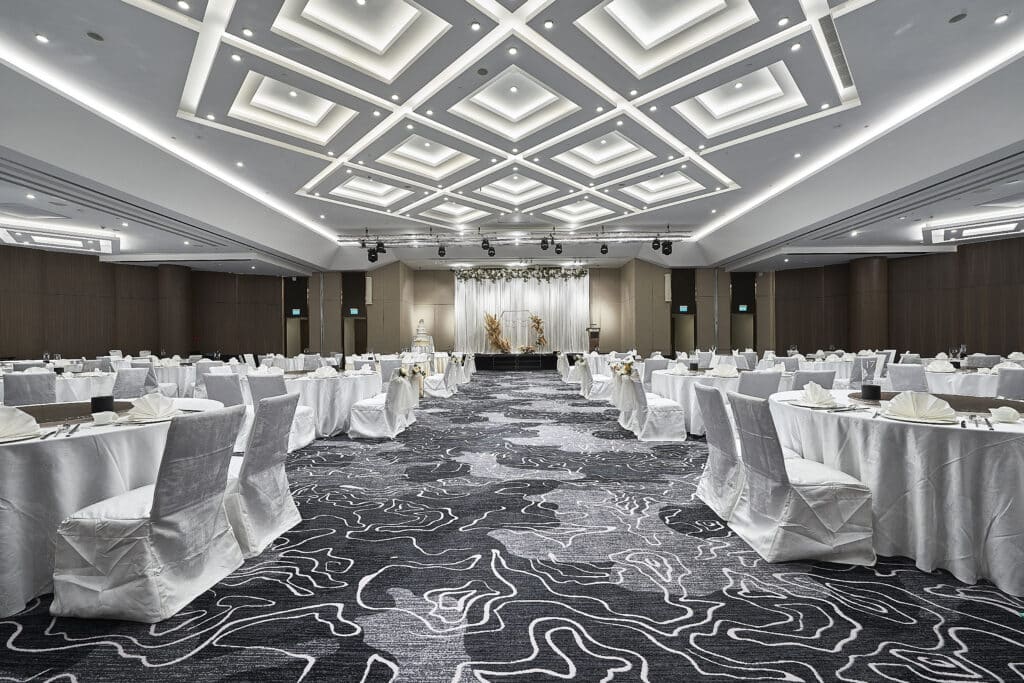
At Goodrich, hybrid specifications are common across our hospitality projects. Dusit Laguna Singapore is a recent example where ballroom and high-impact public spaces used customised hand-tufted carpet while the high-traffic public-area approaches used woven axminster — same colour palette, same designer, two constructions chosen on performance grounds. The result is a coherent visual scheme with each construction working where it belongs.
Yarn Specification: The Often-Overlooked Decision
Construction is one variable. Yarn is the other, and it is where many otherwise good specifications fall short. Hand-tufted and axminster carpets at Goodrich are available in pure new wool, nylon, silk, and bamboo blends — and the yarn choice changes the carpet’s behaviour at least as much as the construction does.
- Pure new wool is the hospitality default for ballrooms and signature spaces. It has natural soil resistance, springs back from compression, ages gracefully rather than visibly degrading, and is inherently flame retardant under most fire codes. Cost is the trade-off; wool is the most expensive yarn family.
- Nylon (typically solution-dyed) is the workhorse for very-high-traffic public areas. Better stain resistance than wool, lower cost, longer wear life under abrasion. The aesthetic is slightly less refined under direct light, which is why it is rarely used in ballrooms.
- Wool-nylon blends (typically 80/20) attempt to combine the aesthetic of wool with the wear of nylon. They are common in high-end corridors and conference areas where neither pure wool nor pure nylon would be the right answer alone.
- Silk is used as an accent yarn — never a full carpet — to create highlights and lustre in specific design elements within a hand-tufted pattern.
- Bamboo is a viscose-process yarn with a soft hand and natural sheen. It is used in design-led residential and boutique hospitality where the sustainability story is part of the brief.
Certification and Sustainability
For projects pursuing BCA Green Mark or WELL certification, both hand-tufted and axminster from Goodrich can be specified with the relevant credentials. Our hospitality broadloom range carries Singapore Green Building Product Certification (SGBC) ratings, and individual products can support indoor-air-quality, low-VOC, and recycled-content credits. Specifying SGBC-certified carpet from the start is far easier than trying to substitute mid-project to satisfy a certification gap.
For full-life-cycle thinking, woven axminster’s longer service life and superior tuft retention generally produce a better whole-life-carbon outcome in very-high-traffic positions. Hand-tufted’s value sits more in the design and atmosphere it creates than in lifecycle metrics — which is exactly the right way to frame the trade-off when presenting the spec to an asset owner.
The Goodrich Project Track Record
Both constructions are core to our hospitality work. Hand-tufted custom carpet has been delivered to Tower Club Singapore, Atlantis The Palm Dubai, the InterContinental Jakarta, Citadines Mount Sophia, the Grand Hyatt, and across the ballrooms of Dusit Laguna and the Marriott Residences in Saigon, among many others. Axminster broadloom is in service at Pullman Singapore, Furama Riverfront, Dorsett, Copthorne King, Holiday Inn Atrium, Shangri-La Restaurant Malaysia, the Marina Cruise Centre, and across multiple international airport, casino, and conference projects in our regional portfolio.
That track record matters because the production-and-installation pipeline is where most carpet projects fail. Custom hospitality broadloom — hand-tufted or axminster — involves design development, yarn dye-lot management, sample approvals, factory production, freight, on-site cutting and seaming, and installation under a fitting-out schedule that is rarely flexible. A specifier choosing between the two constructions is also choosing a project execution chain. Working with a partner who has delivered both at scale, in your asset class, in your geography, is the practical risk-management decision that sits underneath the technical comparison.
How to Brief Goodrich for a Hospitality Carpet Project
The fastest route to a confident specification is a structured brief that lets us match the construction to the room. The five questions we work through with specifiers are: room function and traffic profile; design intent (pattern, colours, brand language); refurbishment cycle and target service life; sustainability and certification requirements; and project timeline through to handover. With those answers, the construction decision typically becomes obvious, and we can move directly to design development and sample approval.
Speak to our hospitality carpet team to scope hand-tufted or axminster broadloom for your next project. Browse the full Goodrich carpet collection or our e-catalogue for design references and technical specifications, and see more hospitality project case studies.