Industry Insights
Architectural Adhesive Film for Occupied-Space Refurbishment
Architectural adhesive film has quietly become one of the most useful materials in the Singapore retrofit specifier’s toolkit. The product itself — a self-adhesive decorative film engineered to wrap interior surfaces — looks unassuming on a sample card. What it solves is anything but unassuming: how to refresh a building, a tenant fit-out, or an asset reposition without taking the asset out of service, without producing demolition waste, and without the cost basis of a full strip-out and replacement.
At Goodrich, we have specified Sangetsu’s REATEC architectural adhesive film into projects ranging from retail flagships to private residences to corporate office refreshes for over a decade. It is not a substitute for every wallcovering or laminate decision, but where it fits the brief — and there are more situations where it fits than most specifiers initially recognise — it is one of the highest-leverage interventions available in commercial interior work.
What Architectural Adhesive Film Actually Is
Architectural adhesive film is a multi-layer self-adhesive vinyl product. The face of the film is printed and embossed to replicate timber, stone, leather, fabric, metal, concrete, terrazzo, and a wide range of solid colours. The back carries a precisely engineered pressure-sensitive adhesive — typically with channel-release technology that lets installers reposition the film during application and squeeze out trapped air. The film is designed for interior use on flat or gently curved substrates: doors, panels, furniture surfaces, columns, lift doors, joinery, ceilings, and feature walls.
The print quality on current-generation product is genuinely difficult to distinguish from natural materials at normal viewing distance, particularly for wood-grain, stone, and concrete looks. The embossed-in-register surface texture aligns to the printed pattern, so the grain you see is the grain you feel under your hand. UV-resistant ink technology and dimensional stability of the film carrier mean that fade and shrinkage are not what they were ten years ago.
The Sangetsu REATEC range that Goodrich carries spans hundreds of design references across the major texture families, and it is specifically engineered for joinery, doors, windows, furniture, columns, lift doors, and panels — the exact surfaces a retrofit project needs to address.
Why Adhesive Film Matters in Retrofit, Specifically
The case for adhesive film is strongest in occupied-asset retrofit, and weakest in new-build. In new-build, you can specify the door, the panel, the column finish from scratch in the right material; there is no incumbent to refresh. In retrofit, the calculus is different.
The economics of not removing what is already there
A fire-rated lift door that is fundamentally sound but visually tired costs about $200 to refinish in adhesive film. The same door, replaced, is a $3,000-to-$8,000 procurement-and-installation exercise that may also require fire compliance re-certification. A laminate-finish reception counter that is structurally fine but five visual generations behind costs about $800 to refilm and a weekend to install. Replaced, it is a six-figure procurement programme. The economics do not favour replacement when replacement is not technically necessary.
The waste calculus
Demolition produces waste — typically construction-and-demolition waste that must be sorted, removed, and disposed of through a regulated stream. For a building targeting a Green Mark Restoration credit, an asset owner pursuing a public sustainability commitment, or a tenant working under a corporate ESG mandate, generating avoidable demolition waste is increasingly something specifiers are asked to defend. Adhesive film generates almost no demolition waste.
Asset operability during work
An adhesive film refurbishment can typically be carried out room by room, overnight, while an asset remains operational. A demolition-and-replacement programme requires phased shutdown, hoarding, and substantial disruption. For hotels, retail, F&B, hospitals, and corporate offices that cannot pause operations, the operational continuity case for adhesive film is often the deciding factor before cost is even weighed.

Where Adhesive Film Earns Its Place
Lift cars and lift doors
Lift doors and lift-car interiors take a beating — fingerprints, scuffs, bumps from trolleys, cleaning chemicals — and they are also the surface every visitor scrutinises while waiting for the doors to open. Adhesive film refreshes a lift programme at a fraction of the cost of replacing or refinishing in stainless steel or laminate. Wood-grain, brushed metal, and stone-look films all read convincingly in lift-car lighting conditions.
Doors and door frames
Internal doors — particularly fire-rated doors that are otherwise expensive to replace — are excellent candidates. Adhesive film refreshes the visible face without disturbing the certified door assembly. For asset owners with hundreds of doors across a building, the labour-and-material cost difference between film and replacement is decisive.
Columns and structural elements
Building columns are typically clad to a finish that is hard to refresh — plaster-and-paint that needs full re-skim, or laminate that requires demolition and rebuild. Adhesive film wraps columns directly over the existing finish (assuming sound substrate) and converts a column from a problem element into a design feature. Stone-look and timber wrap films are particularly effective on structural columns in lobbies, restaurants, and retail floors.
Joinery and built-in furniture surfaces
Reception desks, bar fronts, banquette housings, retail display units — all are surfaces where the substrate is sound but the finish has aged. Adhesive film refilms the visible surfaces, often within a single overnight installation, and the joinery can be back in service the next morning.
Bomb shelter doors and unsightly utility surfaces
Singapore residential and some commercial assets have bomb shelter doors that are functionally critical but visually intrusive. Adhesive film disguises them — wrapped in a wood-grain or pattern matching the surrounding cabinetry, the door becomes invisible without compromising its function. The same logic applies to electrical panel doors, riser cupboards, and other utility surfaces that no design language wants to feature.
Retail and F&B fast-cycle refresh
Retail and F&B operators rotate brand presentation on cycles measured in seasons, not years. Adhesive film fits that rhythm. A storefront, a feature wall, a service counter can be refilmed for a campaign or a pop-up and replaced again three months later. The capital efficiency of film for high-frequency-refresh formats is a structural advantage over hard finishes.
Showrooms and experiential spaces
Showroom interiors that need to refresh between collection launches, or experiential spaces that change theme between events, are natural candidates for adhesive film. The product allows the experiential design language to evolve at the speed the brand operates without the capital exposure of repeated joinery rebuilds.
Substrate and Site Conditions: Where Film Does Not Fit
Architectural adhesive film is a high-performance product within its design envelope, and it will fail outside it. The substrate must be flat or gently curved, sound, dry, clean, and chemically compatible. Specific situations to flag:
- Wet areas with standing water or constant moisture. Film is moisture-tolerant, not waterproof at the seam. Bathroom feature walls are fine; shower-stall walls are not.
- Heavy abrasion zones. Film handles normal commercial wear, not abrasion from cleaning trolley impact or constant heavy hand contact at the same point. Wall protection systems are the right answer there, not film.
- Substrates with active movement. If the underlying material is delaminating, swelling, or unstable, film will telegraph the problem rather than hide it. Substrate remediation is a precondition.
- Sharp internal corners and complex curvature. Film handles gentle curves and radiused edges; tight internal corners require seam planning and may not produce a continuous-look finish.
- Outdoor exposure. REATEC and equivalent products are interior-rated. Outdoor UV and weather exposure are outside the design envelope.
Installation: The Variable That Determines Outcome
Adhesive film is a high-skill installation. The product itself is robust, but the difference between a film application that looks like a precisely engineered finish and one that looks like a quick fix is entirely in the installation. Air bubbles, pattern misalignment, edge lift, seam visibility, and corner handling are all installer-quality issues, not product issues.
For projects of any scale, specifying both the product and the installation through a single supplier — Goodrich provides supply and installation for REATEC across Singapore — is the structural risk control. The installation team is trained on the specific film, the adhesive system, and the substrate prep workflow. On occupied-asset retrofits where a single visible defect undermines the case for film as a strategy, this matters more than it does on new-build wallcovering jobs where a poor seam is annoying but not strategic.
Specifying Film Within a Larger Refurbishment Strategy
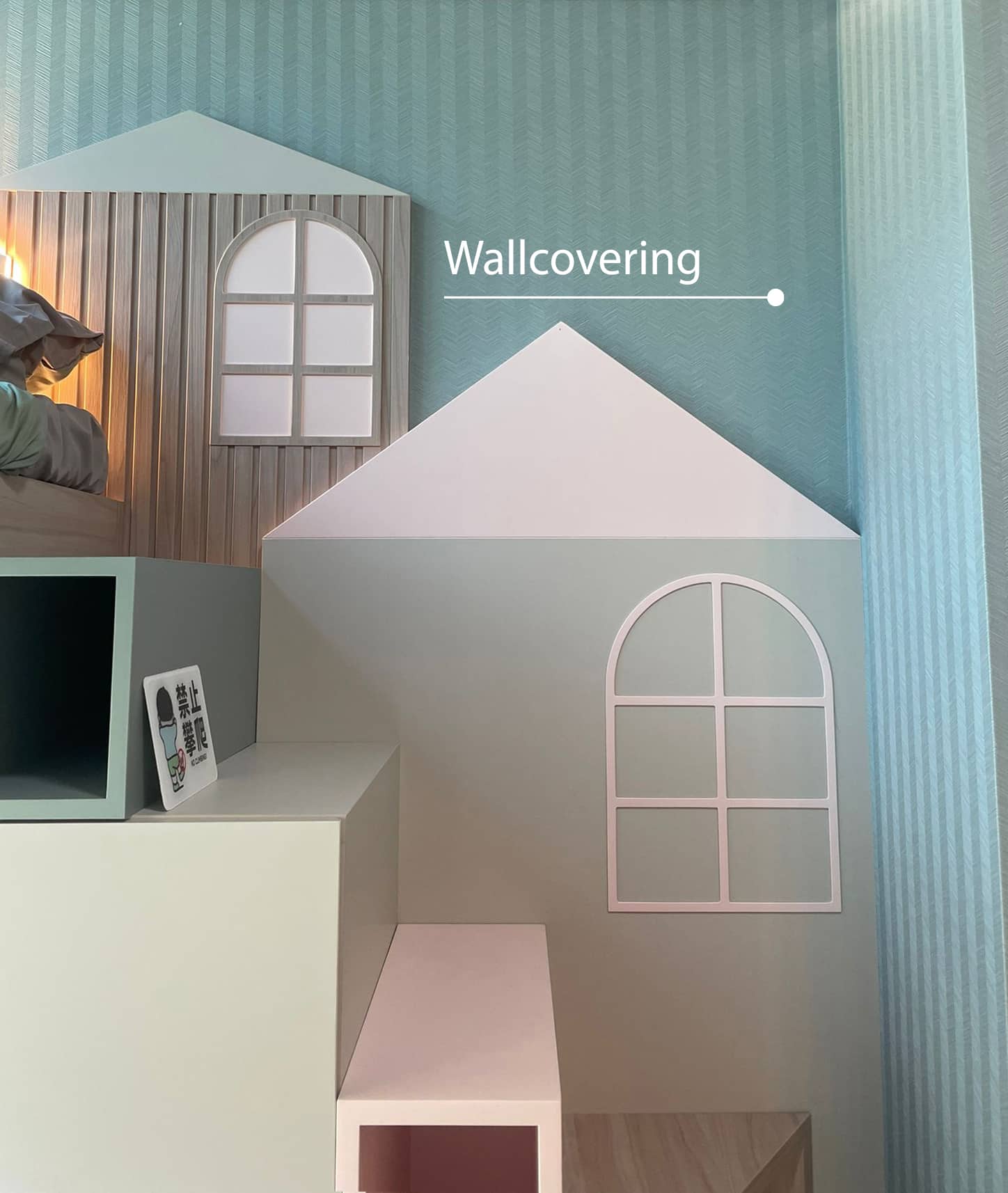
Adhesive film is at its most powerful when it is specified as one element of a coordinated retrofit strategy, not in isolation. The strongest occupied-space refresh briefs use film to address the high-touch, high-visibility surfaces — doors, columns, joinery — while pairing it with click-system vinyl flooring for floors that need refreshing without subfloor demolition, replaceable acoustic and decorative wallcoverings for wall planes, and writable/magnetic surfaces where collaborative use justifies the spec. The total intervention reads as a full refurbishment to occupants while requiring only weekend or overnight site access.
This is the strategy we increasingly recommend to corporate tenants on five-year and ten-year lease cycles. Mid-lease refreshes that previously required moving teams to swing space can now be delivered in stages over a series of weekends. The asset owner is happy because the lease term refresh keeps the asset competitive; the tenant is happy because operations never paused.
Lifecycle and End-of-Use
Adhesive film typical service life is seven to ten years in interior commercial use, longer in protected residential applications. At end of service, the film is mechanically removed; some adhesive residue may remain depending on the substrate and is removed with appropriate solvents. The substrate underneath, if it was sound when filmed, is generally still sound when the film is removed — and ready for either refilming or a different finish.
This reversibility is itself a strategic advantage for tenants in leased space. Adhesive film does not commit a landlord-owned door or column to a permanent finish change. At lease end, the surfaces revert to substrate, and the next tenant inherits an unencumbered space.
How to Scope a Film-Based Retrofit With Goodrich
The shortest path to a confident film specification is a site walk. We assess substrate condition, identify which surfaces are good film candidates and which require remediation or alternative treatments, develop a sample board for design alignment, scope the installation programme around the operational constraints of the asset, and quote on a supply-and-install basis. For multi-phase refreshes across hospitality groups, retail chains, or corporate office portfolios, the same scoping process scales — what is consistent across phases is locked in, what is bespoke is identified upfront.
Speak to our retrofit team about scoping an architectural adhesive film programme for your asset. Browse the Goodrich e-catalogue for the full REATEC reference range, or see project case studies for examples of film-led retrofits across retail, hospitality, and commercial work in Singapore and the region.