Carpet & Flooring
Timber Flooring in Singapore: Wood and Alternatives
Timber Flooring in Singapore’s Tropical Climate
Timber flooring brings natural warmth, character, and timeless beauty to any interior. The organic grain patterns, tactile warmth underfoot, and the way wood ages gracefully over time make it one of the most desirable flooring materials worldwide.
Singapore’s tropical climate, however, presents genuine challenges for natural wood. Year-round humidity levels that fluctuate between 60% and 95%, combined with frequent air-conditioning use that drops indoor humidity dramatically, create conditions that cause natural wood to expand and contract repeatedly. This cyclical movement can lead to gaps between boards, cupping, warping, and other structural issues.
Understanding the different timber flooring options — and the alternatives that capture timber’s aesthetic without its climate vulnerabilities — is essential for making a sound decision.
Solid Timber Flooring
Solid timber flooring is milled from a single piece of hardwood, typically 18 mm to 20 mm thick. Species commonly used in Singapore include teak, oak, walnut, merbau, and kempas. Each species has distinctive grain patterns, colour tones, and hardness ratings.
The Janka hardness scale measures a wood species’ resistance to denting and wear. For Singapore homes, species with Janka ratings above 1,000 lbf are recommended for living areas:
- Teak: Janka 1,070 lbf. Naturally oily, resists moisture and insects. Golden-brown colour deepens with age.
- Merbau: Janka 1,925 lbf. Extremely hard, reddish-brown with yellow flecks. Popular in Southeast Asian homes.
- Oak: Janka 1,290 lbf. Versatile, available in many finishes. Pronounced grain pattern.
- Walnut: Janka 1,010 lbf. Rich chocolate-brown tones. Softer than oak but prized for its warmth.
Solid timber can be sanded and refinished multiple times over its lifespan, potentially lasting 50 years or more. However, it requires careful acclimatisation before installation, a stable indoor environment (ideally 40% to 60% relative humidity), and regular maintenance including periodic oiling or lacquering.
Engineered Timber Flooring
Engineered timber addresses many of solid wood’s climate vulnerabilities while retaining the authentic look and feel of real wood. It consists of a real timber veneer (typically 2 mm to 6 mm thick) bonded to multiple layers of plywood or HDF (high-density fibreboard) arranged in cross-grain construction.
This cross-layer design is the key innovation. By orienting each plywood layer perpendicular to the one above, the board resists expansion and contraction far more effectively than solid wood. This dimensional stability makes engineered timber significantly better suited to Singapore’s humidity fluctuations.
| Factor | Solid Timber | Engineered Timber |
|---|---|---|
| Top layer | Full solid wood | Real wood veneer (2-6 mm) |
| Dimensional stability | Moderate to low | High |
| Suitable for Singapore climate | Requires careful management | Well-suited |
| Refinishing potential | Multiple times | 1 to 3 times (depends on veneer thickness) |
| Installation over concrete | Requires extensive preparation | Simpler with click-lock or glue-down |
| Cost | Higher | Moderate to high |
| Lifespan | 30 to 50+ years | 20 to 30 years |
Engineered timber is the most popular real-wood flooring choice in Singapore condominiums and landed properties. It can be installed as a floating floor over most subfloors, glued down for a more permanent result, or even nailed to timber battens.
Timber-Look Vinyl Flooring
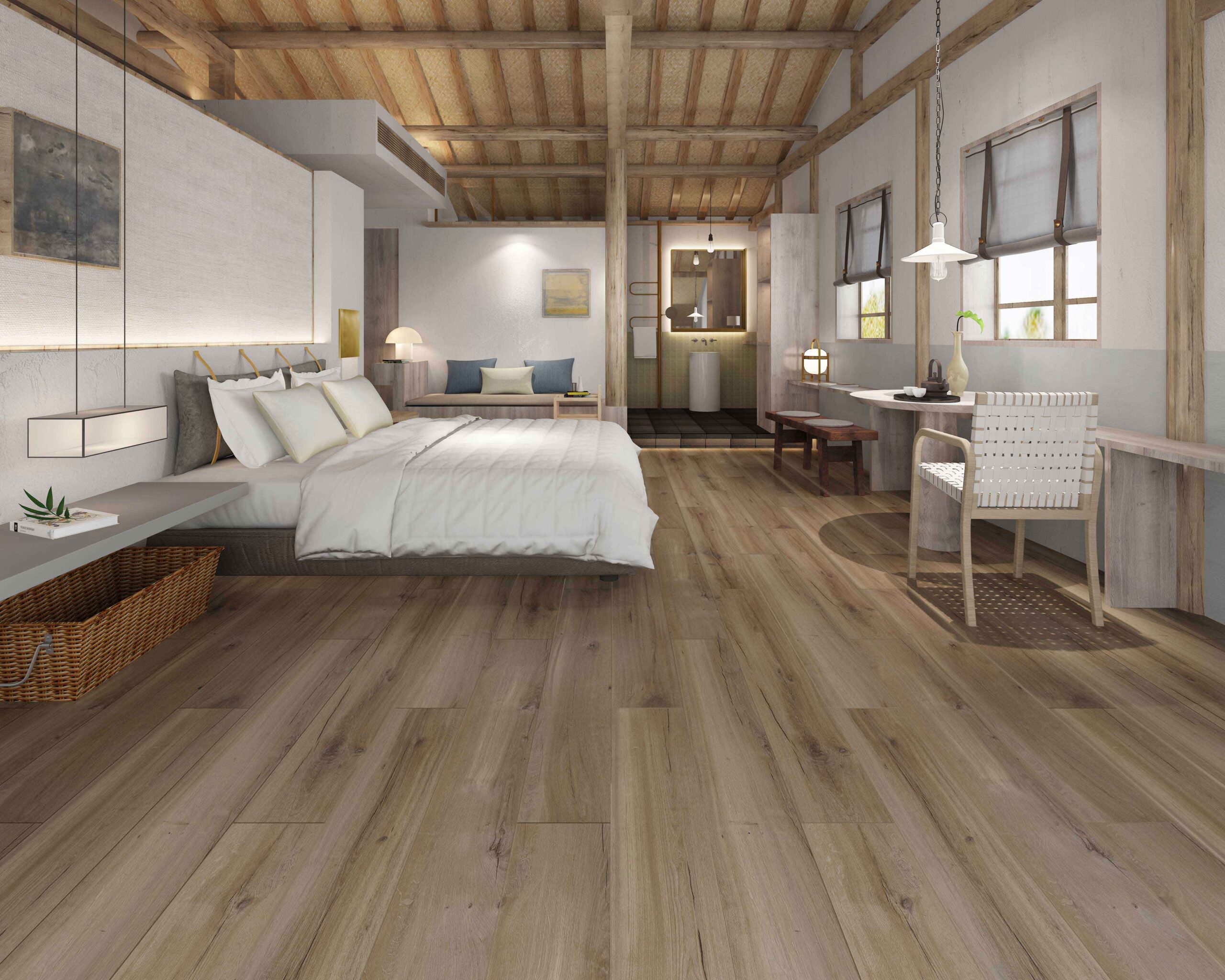
For homeowners who love the look of timber but want maximum practicality, timber-look luxury vinyl flooring has become a compelling option. Modern manufacturing produces vinyl planks with high-definition wood grain visuals and registered embossing that closely mimics the feel of real timber.
The practical advantages are significant. Vinyl is fully waterproof, making it suitable for every room including kitchens and bathrooms — areas where even engineered timber requires caution. It is softer and warmer underfoot than tiles, requires minimal maintenance, and is impervious to termite damage, a genuine concern with natural timber in tropical Singapore.
Timber-look vinyl is available in virtually every wood species and finish imaginable — from blonde Scandinavian birch to dark smoked oak, from rustic reclaimed-look planks to sleek, contemporary smooth finishes. Plank dimensions mirror those of real timber boards, typically 150 mm to 230 mm wide.
For HDB flats and BTO units, timber-look vinyl offers the best balance of aesthetics, performance, and value. It can be installed directly over existing floors, keeps renovation costs manageable, and handles Singapore’s climate without any of the humidity-related issues that affect real wood.
Caring for Timber and Timber-Look Flooring in Singapore
Maintenance requirements vary significantly between real timber and vinyl alternatives, and understanding these differences upfront prevents frustration down the line.
Solid and engineered timber care: Real wood floors need protection from excessive moisture. Wipe up spills immediately and never wet-mop timber flooring — use a well-wrung damp mop only. In Singapore’s climate, running the air-conditioner consistently helps maintain stable indoor humidity, which reduces the expansion and contraction cycles that cause gaps and cupping. Periodic maintenance coats of oil or lacquer — typically every one to three years depending on traffic — refresh the finish and restore protection.
Termite prevention: Subterranean termites are active throughout Singapore and pose a real threat to natural wood flooring. Pre-installation soil treatment, regular inspections (particularly around perimeter walls and pipe penetrations), and prompt attention to any signs of termite activity are essential precautions. Teak is naturally more termite-resistant than most other species due to its oil content, but no wood is completely immune.
Timber-look vinyl care: Maintenance is far simpler. Regular sweeping removes grit, and weekly damp mopping with a pH-neutral cleaner keeps the surface clean. There is no need for oiling, lacquering, or termite treatment. Avoid steam mops and abrasive cleaning products, which can damage the wear layer.
Choosing the Right Timber Flooring Option
The right choice depends on your property type, budget, lifestyle, and design priorities.
Landed properties and high-end condominiums: Solid or engineered timber delivers an unmatched sense of quality and natural beauty. If you can commit to the maintenance requirements and control indoor humidity with air-conditioning, real wood flooring is a worthwhile investment that adds genuine value to the property.
Condominiums with acoustic requirements: Engineered timber with an acoustic underlayment, or timber-look vinyl with built-in sound-dampening backing, both meet typical condo noise regulations while delivering the timber aesthetic.
HDB and BTO flats: Timber-look vinyl is the most practical choice for most HDB homeowners. It is affordable, waterproof, easy to maintain, and can be replaced without major renovation when you are ready for a change. Engineered timber is also viable for those willing to invest more.
Rental properties: Vinyl with click-lock installation can be laid as a floating floor and removed when you move out — ideal for tenants who want a timber look without permanent modifications.
Children’s play areas and family rooms: Timber-look vinyl is the clear winner for homes with young children. It withstands toy impacts, spills, and heavy use without showing damage, and its waterproof nature means accidents are cleaned up without consequence. Real timber, by contrast, can be dented by dropped toys and stained by juice or paint spills.
Whatever your choice, the key is matching the material to your lifestyle and property circumstances. A beautiful floor that demands more maintenance than you are willing to provide will become a source of frustration rather than pride.
Explore the full range of timber and timber-look flooring options suited to Singapore’s climate, including our extensive luxury vinyl collection. Book an appointment with our design consultants to compare materials side by side and find the right fit for your home.