Industry Insights
Material Specification for Singapore Hotel Ballrooms
Hotel ballrooms are some of the most demanding interior specification briefs in commercial work. The room must read as event-grade luxurious for wedding banquets, gala dinners, and corporate functions. It must perform acoustically across speech, music, and large-group conversation. It must handle very-high-traffic loading during set-up, service, and break-down. It must accept a continuous procession of trolleys, equipment, and crews with no visible damage to soft furnishings. And it must do all of this while supporting the property’s brand language across photography, marketing, and guest impression.
The specification calculus is different from any other space in the hotel. A guestroom is private; a ballroom is the most photographed and most evaluated room the hotel presents to corporate event planners and wedding clients. A corridor is a circulation function; a ballroom is the venue itself. Getting the specification wrong is not a value-engineering problem; it is a property-positioning problem.
At Goodrich, hospitality ballroom specifications are core to our work. References across Pullman, Grand Copthorne Waterfront, Dusit Thani Laguna, Marriott Residences (Grand Marina Saigon), Holiday Inn Atrium, Furama Riverfront, Dorsett, Copthorne King, Aloft, Citadines, and many others span four decades of ballroom carpet, wallcovering, fabric, and flooring specification. This article sets out the framework we apply to the ballroom brief.
The Ballroom Specification Framework
1. Carpet — the visual and acoustic foundation
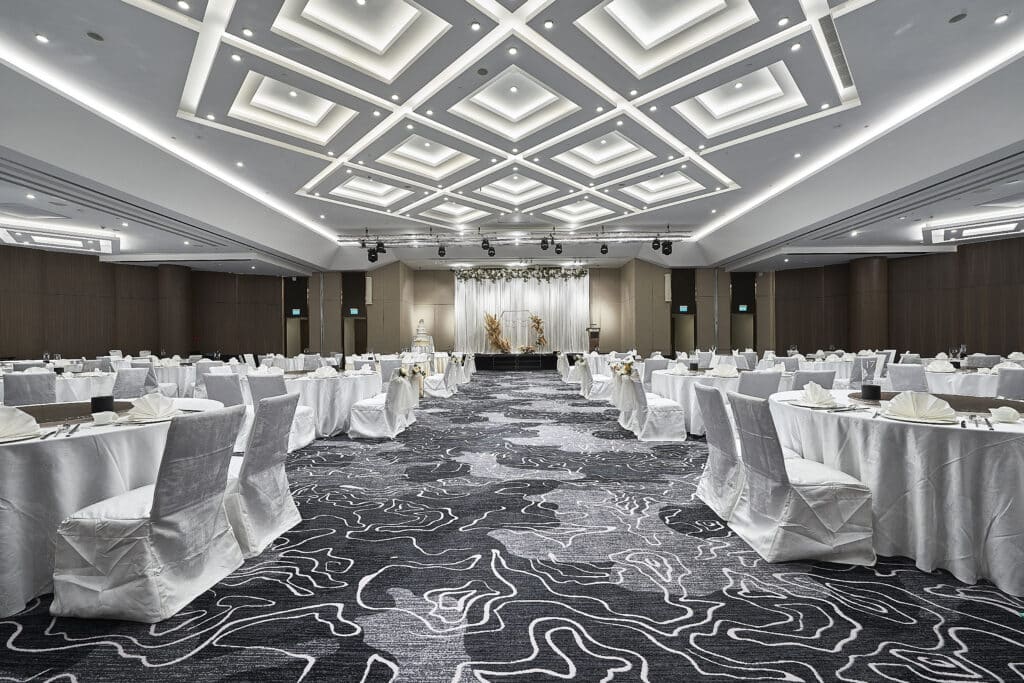
Ballroom carpet is the single largest visual and acoustic element in the room. The decision sits between hand-tufted broadloom and woven axminster — both deliver custom-design capability at hospitality grade, but with materially different construction characteristics. The choice depends on the design intent and the traffic profile.
For ballrooms where the carpet design is a brand asset — sculptural pile, signature patterns, multiple pile heights, extended colour palette — hand-tufted is the right answer. Hand-tufted broadloom delivers effectively unlimited design freedom because each tuft is placed by hand. Service life in a ballroom application is typically 7 to 10 years, aligned with hospitality refurbishment cycles.
For ballrooms where traffic is the dominant variable — heavy event calendars, banquet-style use multiple times per week, continuous trolley and equipment movement — woven axminster delivers the longer service life through mechanical tuft anchorage and higher pile density. Custom design is still possible within the loom constraints (typically 8 to 12 colours in standard production), and the woven construction supports 12- to 15-year service life in very-high-traffic positions.
Many large ballroom projects use both constructions in coordination — hand-tufted in the central ballroom floor where the design is the asset, woven axminster in the pre-function and circulation areas where traffic is the priority. Same colour palette, same designer, two constructions chosen on engineering grounds. Goodrich has delivered exactly this pattern across multiple Singapore hospitality projects.
2. Wallcovering — the design language at vertical scale
Ballroom wallcoverings are some of the largest continuous decorative surfaces in any commercial interior. The specification needs to deliver design language at scale (often 4 to 6 metres of vertical surface), durability against the constant trolley and crew contact during set-up and break-down, fire compliance for public-assembly use, and acoustic compatibility with the absorption budget the room requires.
The Goodrich specification mix for premium ballrooms typically draws from US-made vinyl wallcoverings (Premierwall Azurite — durable, fire retardant, low VOC, antimicrobial), Japanese-craftsmanship references (Sangetsu XSELECT premium wallcovering, Sangetsu Morris Chronicles, Sangetsu Fine), handpainted statement wallcoverings (Goodrich ExclusiveWall Artistic, US-made, signature opulence), and digital printed custom wallcovering for project-specific brand or thematic content.
The fire-retardant rating must align with public-assembly building-code requirements. For public-assembly spaces in Singapore, Class A fire rating is the routine specification expectation. All Goodrich ballroom-grade wallcoverings carry the appropriate fire compliance documentation.
3. Acoustic absorption — the comfort factor
Ballroom acoustics are difficult. The room is large, the surfaces are mostly hard (the ceiling is typically a feature, the walls are wallcovered drywall over substrate), and the use cases span speech (toasts, presentations), music (live and amplified), and large-group conversation (cocktail receptions). A ballroom that sounds bright and reverberant during a wedding ceremony fails for the dinner reception that follows.
The acoustic absorption budget in a ballroom comes from carpet (NRC 0.20 to 0.45), drapery and fabric panels (NRC 0.40 to 0.85 depending on construction), upholstered chairs and tables (NRC variable), and any acoustic ceiling treatment. The specification needs to add up to a reverberation time around 1.0 to 1.4 seconds at mid-frequencies for the room’s primary use cases — long enough for music and atmospheric warmth, short enough for speech intelligibility.
The right ballroom specification coordinates carpet, drapery, and chair upholstery to deliver the absorption budget. Specifying a beautiful carpet, beautiful drapery, and beautiful chair fabric without checking the acoustic numbers is the most common ballroom acoustic failure we see.
4. Drapery and fabric — the soft architecture
Ballroom drapery and fabric specification spans drapery curtains, fabric wall panels, chair upholstery, banquet seating upholstery, and (where applicable) acoustic fabric paneling. The brief is fire compliance (essential), abrasion resistance for chair and banquette fabric (Wyzenbeek 100,000+ for ballroom-grade), aesthetic alignment with the wallcovering and carpet design language, and cleaning chemistry compatibility for the housekeeping protocols.
The Goodrich fabric range for ballrooms typically draws from contract-grade collections (Aldeco, Camengo, Sanderson Design, Sangetsu, Concertex), Cortina pure Italian bovine leather for premium banquette upholstery, and Shield Leathers silicone faux leather where the cleaning-chemistry profile or hydrolysis resistance argues for silicone over PU or natural leather.
5. Lighting and AV coordination
Ballroom material specification interacts with lighting and AV decisions. Wallcovering pattern and texture interact with lighting: matte surfaces read differently under wash lighting than gloss surfaces, and pattern scale interacts with viewing distance and lighting angle. Carpet pattern reads differently under banquet lighting than under wedding-ceremony lighting. AV projection compatibility is a wall-finish consideration where projection mapping is part of the venue capability.
The specification process should include lighting and AV teams from concept stage. Material samples should be evaluated under the lighting conditions the venue will actually operate in, not just under specifier-studio lighting.
The Pre-Function and Circulation Specification
Ballroom specification extends into the pre-function and circulation zones — typically the most heavily trafficked areas in the entire hospitality property because every event guest passes through them on the way to and from the ballroom proper. The specification logic shifts here:
- Carpet: typically woven axminster for the longer service life, design coordinated with the ballroom interior but engineered for higher traffic.
- Wallcovering: durable specification with bumper protection at trolley height where back-of-house service routes intersect.
- Lighting: transition lighting that prepares guests for the event-grade lighting in the ballroom itself.
- Wayfinding and signage: integrated with the wallcovering specification rather than added later.
Service Areas and Back-of-House
The ballroom specification extends into the service areas — service corridors, kitchen-to-ballroom transit routes, banquet pantry, AV control rooms — that support the front-of-house operation. Specification here shifts to durability and serviceability over aesthetics: rigid sheet wall protection, anti-slip vinyl flooring, easy-clean wallcoverings, fire-rated joinery. The success of the front-of-house depends on the back-of-house operating without disruption; service-area specification underwrites the operational reliability.
The Sustainability Layer
For hospitality projects pursuing BCA Green Mark, WELL, or LEED certification, the ballroom specification needs to align with the certification requirements. SGBC-certified products across the carpet, wallcovering, flooring, and fabric range support multiple credit categories. The Goodrich product range carries the relevant certifications across its hospitality specification mix, supporting Green Mark scoring without compromising the design ambition.
Whole-life-carbon thinking increasingly applies. Hand-tufted carpet’s 7- to 10-year service life and woven axminster’s 12- to 15-year service life have different lifecycle carbon profiles. For projects making the lifecycle case explicit, specification-stage discussion of refurbishment cycles and material lifecycle is a meaningful input to the carpet decision.
The Brief: How to Scope a Ballroom Specification with Goodrich
The shortest path to a confident specification is a structured brief covering: room dimensions and capacity (ceremony, banquet, theatre layouts), event calendar and traffic profile, brand and design language, refurbishment cycle and target service life, certification requirements (Green Mark, WELL), AV and lighting capabilities, and budget envelope. With those answers, the major specification decisions — hand-tufted vs axminster, US-made vs Japanese vs handpainted wallcovering, drapery and fabric collection — typically resolve to a clear path. Sample boards, mock-up panels where appropriate, and full design development follow.
Hospitality projects of this scale benefit from supplier continuity across the specification. Coordinating carpet, wallcovering, fabric, and complementary materials through a single source — Goodrich provides supply and installation for the full mix — manages the project execution chain in a way that distributed sourcing cannot. The custom hand-tufted carpet workflow from design development through factory production, freight, on-site cutting and seaming, and installation is a project within the project; it benefits from the same partner who is delivering the wallcovering and fabric scope.
The Goodrich Track Record
Ballroom and hospitality public-area specifications appear across our portfolio in Singapore and the region: Pullman Hotel, Grand Copthorne Waterfront, Dusit Thani Laguna, Marriott Residences (Grand Marina Saigon), Holiday Inn Atrium, Furama Riverfront, Dorsett, Copthorne King, Aloft, Citadines Mount Sophia, Tower Club Singapore, the Grand Hyatt, and across regional hospitality projects from Atlantis The Palm Dubai to InterContinental Jakarta.
Speak to our team to scope ballroom and hospitality public-area specification. Browse hospitality references in the Goodrich e-catalogue, explore the full carpet collection for hand-tufted and axminster references, or see project case studies across our hospitality portfolio.