Industry Insights
University and Polytechnic Interior Material Guide
Singapore tertiary education facilities — universities, polytechnics, autonomous institutions, and offshore international campuses — operate at a scale and complexity that places their interior specifications in their own category. A single university campus may include lecture theatres, classrooms, libraries, laboratories, student common rooms, faculty offices, executive education spaces, residential colleges, dining halls, gym and sports facilities, performance spaces, and visitor-facing functions. Each space type has a distinct specification brief, and the specifications must coordinate across the campus to deliver a coherent institutional experience.
At Goodrich, our tertiary education portfolio spans Nanyang Technological University (NTU), the National University of Singapore, Ngee Ann Polytechnic, Singapore Polytechnic, Nanyang Polytechnic, the Singapore University of Technology and Design (SUTD), the INSEAD Asia Campus, and across regional university work. This article sets out the specification framework we apply to tertiary education work and the categories that consistently earn their place.
The Tertiary Brief: Coordinated Diversity
Tertiary education interiors must serve a diverse population — undergraduate students at high density, graduate students at lower density and longer residency, faculty in working office and meeting environments, visiting academics and corporate guests, prospective students and their families on campus tours. Each population has different expectations and different use patterns. The specification must serve all of them within a coherent institutional design language.
The campus master plan typically defines visual identity and material palette at the institution level. Building-level specifications work within the master to deliver space-specific performance. The specification process scales from individual classroom decisions up to multi-building rollouts coordinated across an entire campus or faculty.
Specification by Space Type
Lecture theatres and large teaching spaces
Large lecture theatres demand acoustic specification engineered for speech intelligibility from the lectern to the back row. The specification combines acoustic wall panels (fabric-wrapped Concertex constructions or Zintra acoustic panels), acoustic ceiling treatment, fixed-seating upholstery at contract grade, and durable corridor flooring transitioning into the theatre proper. Reverberation times in the 0.7 to 1.0 second range are typical for well-specified lecture spaces; below this, the room reads as deadened; above, intelligibility breaks down for amplified speech.
Lighting interaction matters at lecture-theatre scale. Material specifications affect lighting reflection, projection-screen visibility, and the visual relationship between lecturer position and student sightlines. Coordination with lighting and AV specification is part of the material decision, not separate from it.
Classrooms and seminar rooms
Smaller teaching spaces — seminar rooms, tutorial rooms, project rooms — combine lecture-style instruction with group-based collaborative work. The flooring specification can support acoustic comfort (carpet tile or broadloom) where the pedagogical model favours discussion, or hard-surface (vinyl plank) where movable furniture and frequent reconfiguration are part of the use pattern.
Writable wall surfaces (Walltalkers) extend collaborative teaching beyond traditional whiteboard area. Glass film (Sangetsu CLEAS) on glazed walls and windows provides UV cut, glare reduction on screens, and (in privacy-sensitive teaching) selective obscuration.
Libraries and learning commons
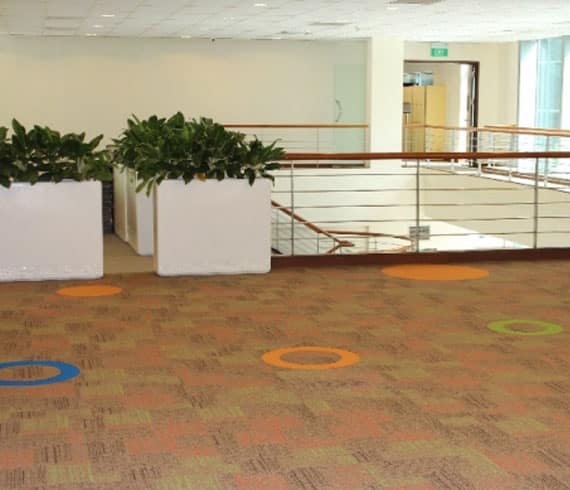
University libraries have evolved into hybrid spaces combining traditional book-collection zones, individual study carrels, group study rooms, computer-equipped collaboration zones, and increasingly sophisticated learning-commons functions. The material specification follows the zoning: carpet broadloom and acoustic specification in study zones, vinyl plank in active-collaboration zones with movable furniture, feature wallcoverings at hero-wall positions, and glass film on glazed elevations to protect the print collection.
Specifications across the largest university libraries in Singapore have to coordinate with the building services, lighting, and AV systems at a level that exceeds typical tertiary spec work. Goodrich library specifications across NTU, NUS, and tertiary partners reflect this complexity.
Laboratories and research spaces
Research laboratory flooring must take chemical exposure, occasional spillage, equipment movement, and antibacterial specification appropriate to the research use. Sangetsu S Floor with anti-slip and shock-absorbing properties is a routine specification; Armstrong Medintech Plus carries Diamond 10 chemical-resistance and antimicrobial coating for higher-specification research environments.
Wall protection (Korogard rigid sheets) in lab corridors and equipment-staging areas extends operational service life. Wallcoverings in lab environments need to be cleanable, fire-rated, and chemical-tolerant — Premierwall Azurite and Widewall Mixture with their fire-retardant, low-VOC, antimicrobial specifications are routine answers.
Student common rooms and informal study
Modern tertiary common rooms have shifted closer to co-working space than traditional student lounges. The specification mix follows: acoustic wallcoverings, modular carpet tile and broadloom, contract-grade lounge furniture upholstered in high-abrasion fabric or silicone faux leather (Shield Leathers — anti-mildew, allergen-free, easy-clean for the student-population cleaning load), writable surfaces, and architectural film for refresh-cycle joinery.
For student-facing spaces, the visual quality matters in recruitment terms — prospective students and families form impressions during campus tours and open-house events. The specification supports the institutional brand at the spaces visitors actually experience.
Faculty offices and meeting rooms
Faculty office and meeting room specifications work like premium corporate office: durable carpet tile or broadloom, vinyl wallcovering with selective decorative wallcovering at feature positions, contract-grade upholstery, glass film for privacy modulation, writable surfaces in collaborative meeting rooms. The specification supports working environments rather than recruitment imagery, and durability is the primary lever.
Executive education and conference facilities
Executive education facilities (such as INSEAD’s Asia Campus model) operate at hospitality-grade specification levels. Carpet specifications include hand-tufted custom carpet for signature spaces, wallcoverings include US-made and Japanese-craftsmanship references, fabric and upholstery specifications include premium contract collections (Aldeco, Camengo, Sanderson, Sangetsu, Concertex). The brief is closer to corporate hospitality than to traditional education.
Sports and gym facilities
Tertiary sports facilities specify rubber flooring, sport-grade hardwood or composite, anti-slip vinyl in changing rooms, antimicrobial flooring across wet zones, and durable wall protection in equipment-staging areas. The specification works alongside the sport-specific floor systems specified for individual courts and training surfaces.
Performance spaces
Concert halls, performance venues, and recital spaces on tertiary campuses combine ballroom-grade acoustic specification with performance-stage equipment requirements. Material specifications include fabric wall panels at acoustic-grade construction, fixed-seating upholstery, stage curtains with fire and abrasion ratings, and circulation flooring at hospitality grade. The acoustic engineering is typically led by acoustic consultants; material specification supports the engineered absorption budget.
Specification at Campus Scale
The specification challenge at university scale is coordination. A multi-building campus spec needs to maintain visual continuity across buildings, allow legitimate variation between space types, support the institutional brand at the photography and tour moments, and deliver operational simplicity for the campus facilities teams.
The Goodrich approach to campus-scale specification: a documented institutional master specification covering each space type, framework supplier agreements that support multi-building rollouts at consistent pricing and lead times, coordinated samples that maintain visual continuity across phases, and operations protocols documented at the master-specification level rather than negotiated per project. The master specification simplifies project execution at every subsequent building and supports the institution’s portfolio-level brand consistency.
The Sustainability and Certification Layer
Tertiary institutions increasingly pursue Green Mark, WELL, or LEED certification at the campus or building level, and the institutional ESG commitments flow through to material specification expectations. Goodrich’s tertiary specification mix supports certification across the spec:
- SGBC-certified flooring across vinyl, carpet, decking, and timber.
- FSC-certified, solar-printed wallcoverings (Ecowall Emerald) for ecological specification.
- PVC-free flooring (Goodrich Eco Resilient Flooring) for institutions specifying PVC-free.
- Low-VOC certifications across the wallcovering range.
- Carbon-reducing flooring (Orchid 3000, world’s first sustainable flooring made of carbon-reducing material, SGBC 4-tick).
- Onewood composite decking with SGBC certification.
The Multi-Campus Reality (Regional Universities)
Universities operating across multiple Singapore campuses, regional offshore campuses, or international branch campuses benefit from specification consistency at the institution level. Same product specifications mean same operational protocols across campuses, consistent visual brand across geographies, and supplier relationships that scale across the institution rather than fragmenting per project. Goodrich’s regional presence (11 countries) supports multi-campus rollouts where the institutional brand requires geographic specification consistency.
The Specification Process
The shortest path to confident tertiary-education specification is a structured brief covering: institutional master plan and capital programme, space schedule per building, certification commitments, brand and design language at the institution level, sustainability and IAQ targets, refurbishment and replacement cycle planning, and budget envelopes per building or per phase. The master specification, framework supplier relationships, and per-building specifications follow from those answers.
Speak to our team to scope a tertiary education interior specification. Browse references in the Goodrich e-catalogue, see project case studies from INSEAD, NTU, Ngee Ann Polytechnic and Singapore University of Technology and Design, or explore the full carpet and flooring ranges.