Carpet & Flooring
Solid Wood Flooring in Singapore: Realities and Modern Alternatives
Ask a flooring installer in Singapore how often they lay genuine solid wood flooring and the answer is usually “a few times a year, if that”. This is not because the appetite for timber has faded — wood looks dominate local renovation moodboards — but because solid timber, as a construction, fits awkwardly into how Singaporeans actually build and live. Understanding why explains a great deal about the modern flooring market.
This guide covers what “solid” specifically means, why the format has become rare in local high-rise homes, where it still earns its place, and how the alternatives ladder — engineered timber and wood-look resilient flooring — took over the territory it vacated.
Goodrich Global does not supply solid timber flooring. Our range covers wood-look luxury vinyl that delivers realistic timber visuals with none of the movement, height or maintenance constraints described below.
What “Solid” Actually Means
A solid wood floorboard is exactly what the name says: one piece of timber, milled from a single sawn plank, typically 15mm to 18mm thick, with a tongue-and-groove profile machined along its edges. There is no core, no backing, no layers — the surface you walk on runs the full thickness of the board.
That distinguishes it from the two constructions that dominate today’s market. Engineered wood carries a 2–6mm hardwood veneer bonded to a plywood or multi-ply core, engineered specifically to resist the movement that plagues solid timber. Wood-look vinyl dispenses with timber altogether, printing the grain onto a resilient plank. Each step down that ladder trades away timber content for dimensional stability — and in Singapore’s climate, stability is the currency that matters. If you are still choosing between the broad categories, our wood-look vinyl versus real wood comparison maps the full decision.
The full-thickness construction gives solid wood its one unrepeatable advantage: sanding allowance. A solid board can be sanded and refinished repeatedly — realistically four to six times over its life — so a well-kept solid floor can outlast the building’s interiors several times over. Century-old solid teak floors in conserved shophouses are proof the format works when conditions suit it.
Why Solid Timber Is Rare in Singapore High-Rises
The problem is that conditions in an HDB flat or condominium rarely suit it, for reasons that are structural before they are aesthetic.
The slab and the fixing problem
Solid timber traditionally gets nailed to a wooden subfloor or to battens. Singapore homes sit on concrete slabs, so a nailed installation requires building up a batten-and-plywood substructure first — adding 30mm or more of height, cost and dead load. Direct glue-down to concrete is possible but demanding: the slab must be moisture-tested and primed, and a full-thickness board transmits far more movement stress to the adhesive line than an engineered board does. Between door clearances, level differences at kitchens and bathrooms, and HDB renovation height limits, the build-up alone disqualifies solid timber from most flats.
Humidity and the air-con cycle
Solid wood moves with moisture, and Singapore delivers a uniquely punishing cycle: 80-plus per cent ambient humidity by day, then hours of dry air-conditioned air by night. A full-thickness board swells and shrinks across its width with each swing, and over months this shows up as cupping, gapping at the joints, or peaking at the edges. Engineered construction was invented precisely to cancel this cross-grain movement; solid boards simply have no counter-balancing layers to restrain them.
The economics of the sanding allowance
Solid wood’s trump card — refinishing every decade or so — also lands differently here. Sanding is a dusty, multi-day, furniture-out operation, difficult to stage in an occupied flat, and Singapore renovation culture tends to replace interiors every 10–15 years anyway. Many owners would never use the second sanding cycle, let alone the fifth, yet the material and installation premium pays for all of them upfront. At S$18–S$35 per square foot installed for quality solid hardwood — against S$12–S$25 for engineered and S$5–S$10 for resilient — that is an expensive unused option.
Where Solid Timber Still Gets Specified
Solid wood has not disappeared; it has retreated to the projects that suit it. Landed homes can accommodate the floor build-up, control humidity zoning more deliberately, and justify the investment over multi-generation ownership horizons. Heritage and conservation work — shophouses, black-and-white houses — often requires like-for-like solid timber replacement as a matter of authenticity, sometimes reusing reclaimed boards.
Species choice matters more for solid than for any other construction, because the whole board must behave. Dense, oily, tropical-proven species fare best; temperate species need more careful acclimatisation. Rather than re-covering that ground here, see our dedicated species guides on teak flooring, oak flooring and walnut flooring, each of which covers how the species performs across solid, engineered and vinyl formats.
The Maintenance Commitment
Owning solid wood is an ongoing relationship. Lacquered finishes need recoating every five to eight years as traffic dulls them; oiled finishes ask for maintenance oiling annually or so, in exchange for easier spot repair. Spills must be wiped promptly, felt pads are non-negotiable under furniture, and steam mops are forbidden. Indoor humidity ideally stays within a moderate band, which in practice means consistent air-conditioning habits or accepting seasonal gapping as part of the floor’s character.
None of this is unreasonable for an owner who loves the material. But it is a commitment, and it is precisely the commitment that the alternatives were engineered to remove.
The Modern Alternatives Ladder
For most Singapore homes the realistic question is not “solid or nothing” but “how much timber do I actually need in the construction”. The ladder has two rungs.
Engineered wood keeps a genuine hardwood surface — the same species, grades and finishes as solid — on a cross-laminated core that tames humidity movement. It glues or floats over concrete at 10–15mm thickness, and better products still allow one or two light re-sands. It is the honest successor to solid timber for owners who want real wood underfoot; our engineered wood flooring guide covers specifications and costs in full.
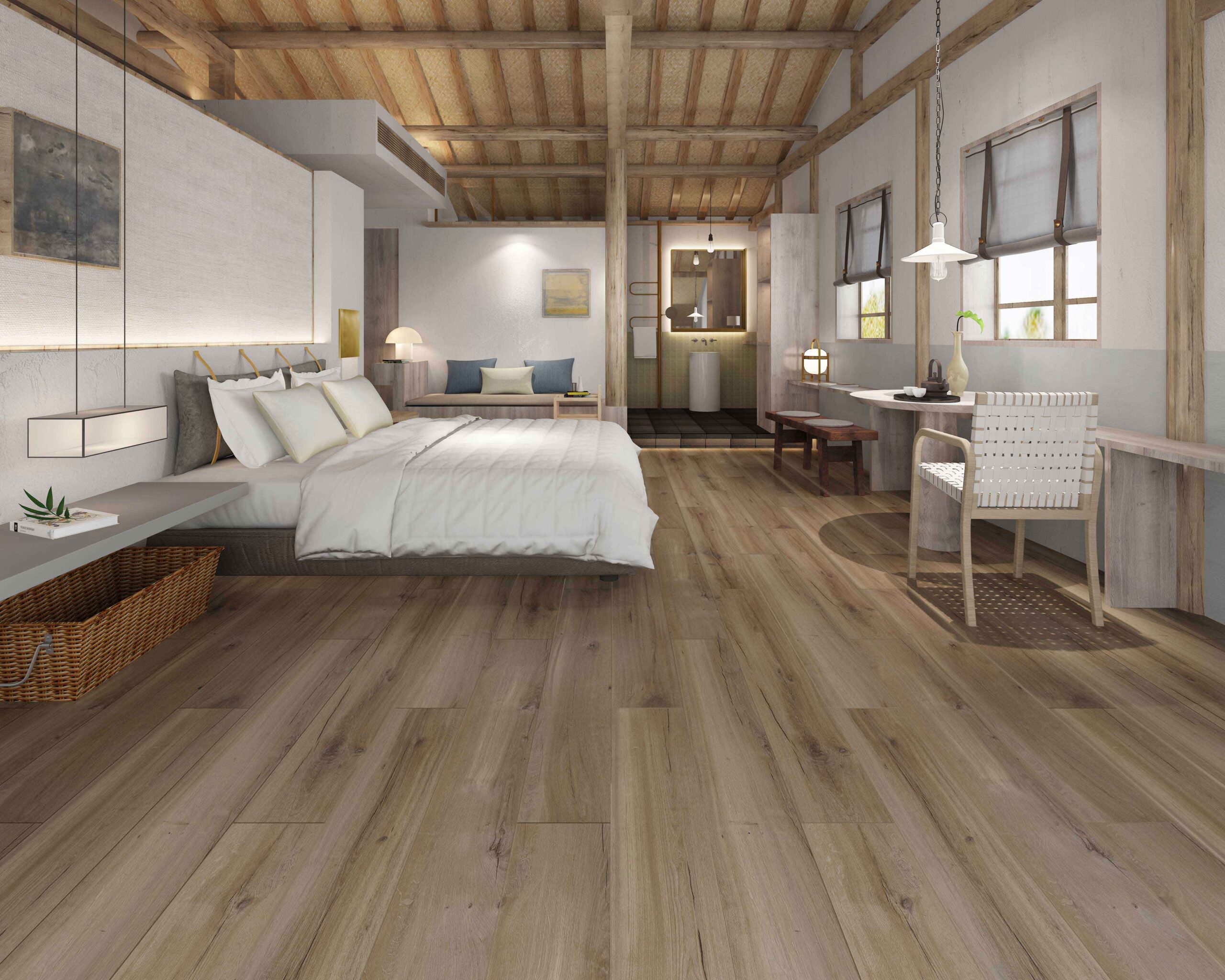
Wood-look luxury vinyl takes the final step: the timber visual without the timber. Registered embossing follows the printed grain, formats run from strips to wide planks and herringbone, and the material is entirely indifferent to humidity, spills and steam mops. At 4–5mm thick it raises no height issues, installs in days, and a damaged plank is swapped rather than sanded. For rental properties, family homes and any room where water may reach the floor, it is the pragmatic endpoint of the ladder — and the full flooring range includes options for every room and budget.
Final Thoughts
Solid wood flooring remains a beautiful, generational material — in the right building. In Singapore’s high-rise, concrete-slab, air-conditioned reality, its construction works against it: the fixing build-up, the humidity movement, and a refinishing economy that most owners never use. Landed and heritage projects will keep specifying it, and rightly so. For everyone else, engineered wood preserves the authentic surface with far better behaviour, and wood-look vinyl delivers the aesthetic with none of the commitments. The best way to calibrate your own trade-off is to put the options side by side and underfoot.
Book a showroom appointment to walk wood-look vinyl formats side by side and find the timber visual that fits your home and budget.